
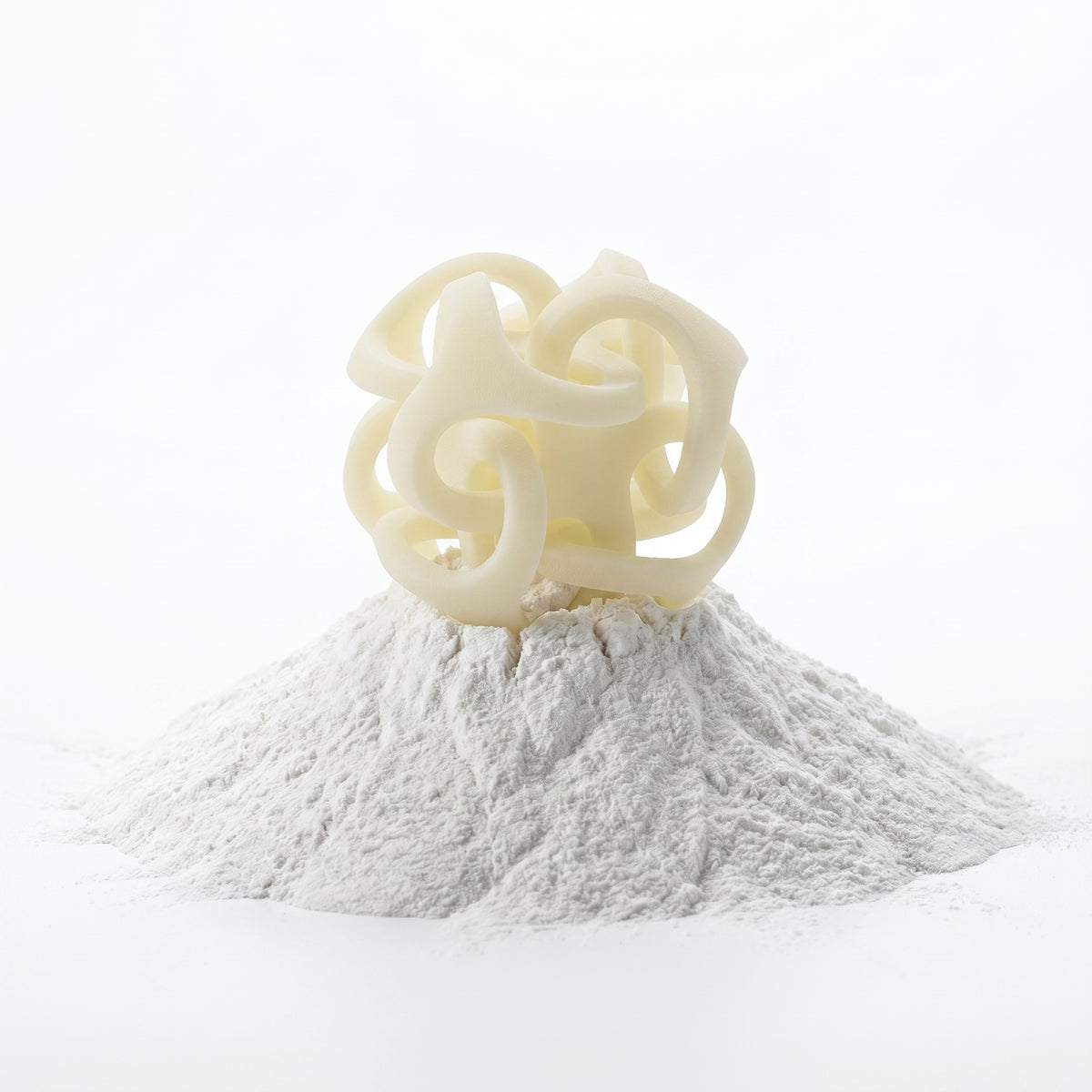
Pó Sinterit PA12 material

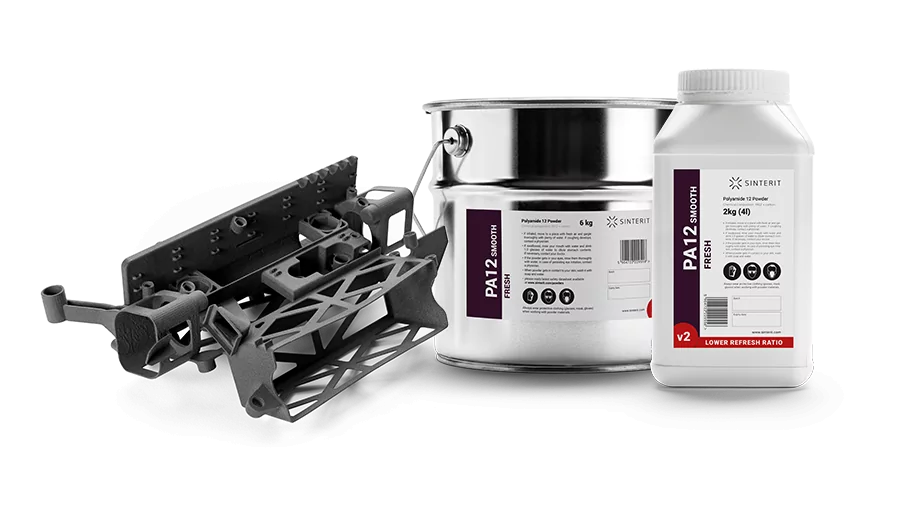
O que você precisa saber sobre este material
Sobre o material
excellent quality print surface and details A cost effective nylon 12 powder with excellent surface resolution It is the ratio of a minimum amount of
excellent quality print surface and details A cost effective nylon 12 powder with excellent surface resolution It is the ratio of a minimum amount of fresh powder needed in a mixture of material used in an SLS 3D printer. A lower refresh ratio means better cost-efficiency of the material. The amount of needed fresh powder is automatically calculated by our software and shown on the printer screen after the print job is finished. Just add shown amount of material into the mixing cycle of used material and you can start your next job with refreshed material To start SLS 3D printing you need the powder starter pack. After that, you’ll only need to refresh the powder you own with fresh powder. – Store the powder at room conditions ( ~23°C and 50% humidity – the lower humidity the better) – Always store the material in a sealed dry box/container. – Do not leave the container open. – Clean the machine directly after printing and store the material immediately after removing the print cake. – Do not let the powder stay in the printer for more than a couple hours. – Put a few silicone absorbers in the container (but don’t add them to the printer) Contact Sinterit support with your questions. Starter powder is basically a print-ready powder. In Sinterit we distinguish three powder conditions: print-ready, used, and fresh. Used is a type of powder that you get after the printing, present in overflow bin or remaining after printout cleaning. Fresh is a type of powder that is being used for refreshing the powder. After mixing this powder with used powder you will receive print-ready. Print-ready is a type of powder that you can simply pour into the printer and start printing. Although printing using Fresh is possible it’s not economically optimal therefore Sinterit printers are optimized for using a refreshed (print-ready) powder. SLS polyamide powder used for 3D printing is considered particulate matter because of its size. Polyamide powder particles are generally 40 micrometers or smaller. If vacuumed in an ordinary vacuum cleaner, the powder could cause an explosion. Such materials are subject to labor regulations on air quality and occupational safety. The procedures call for appropriate maintenance of powder at work. Only certified industrial vacuum cleaners should be used to clean such materials. More information about the ATEX Vacuum cleaner can be found here. Contact Sinterit support with your questions. PA12 Smooth is a cost-effective Nylon 12 powder offering excellent surface resolution, good chemical resistance, and a great quality-to-price ratio. It’s ideal for detailed prints and general prototyping. Yes, it has been tested under ISO 10993 standards and found to be non-cytotoxic and non-irritant—but final use applications must be validated by the manufacturer. It is compatible with the Sinterit Lisa X, as well as older printer generations: Lisa and Lisa Pro. No, nitrogen is not required when printing with PA12 Smooth. PA12 Smooth works well for structural or mechanical elements, complex shapes, final parts, and chemically resistant prototypes. The refresh ratio is 22%, meaning 22% fresh powder should be mixed with 78% unsintered material from the previous print. It offers high chemical resistance, suitable for parts exposed to various chemicals. For detailed resistance data, contact Sinterit. PA12 Smooth is specifically formulated to deliver excellent surface quality and fine detail reproduction, even on complex geometries. We have received the Suzy for printing and started it up with PA 11.5. The first prints turned out really well. But what’s huge is we reduced printing time for a full build space by more than fifty percent. Thank you very much for convincing me to make the switch from PA12. I believe that we will be able to quickly implement a new product line with PA11.5 by the end of the year. Sinterit’s Lisa X has allowed us to reduce lead-times and create better solutions — faster, helping us satisfy our customers. We have looked at other 3D printing methods, and other brands, but ultimately decided on SLS and chose Sinterit for their communication, and open material possibility. Something we couldn’t find in other suppliers of affordable entry level SLS printers. Getting Lisa X solved a lot of our problems. It has a big enough printing area, so we almost always can print big components in one part. It wouldn’t be possible with competitive SLS 3D printing solutions. The main reason Somfy reached out for the SLS technology from Sinterit was productivity. Printing many pieces in one batch was a game-changer When we look at Lisa’s line of printers, or Sinterit at general compared to other companies, the two major things that we liked were the materials, that are open source, so we are not locked into one brand […]. We are able to look around the market and use a material that works best for the part. Need a 3D Printer tailored for this purpose? Your concerns may include costs, ROI, customer support, print quality, or printing speed. We have helped thousands of companies make the right choice. The Administrator of your personal data is Sinterit Sp. z o.o. with its registered seat in Krakow, ul. Nad Drwina 10 bud. B3, 30-741 Krakow, entered in the register of entrepreneurs kept by the District Court for Krakow - Śródmieście in Kraków, XI Economic Division of the National Court Register under KRS number: 0000535095, tax identification number (NIP): 6793106416. Your personal data will be processed solely for the purpose of providing you with an answer to the enquiry sent via the contact form. The legal basis for the processing is your freely given consent (Article 6(1)(a) of the RODO/GDPR), which is necessary to fulfil the indicated purpose. Your data will be stored for the period necessary to respond or until you withdraw your consent. You may withdraw your given consent to the processing of your personal data at any time, which does not affect the lawfulness of the processing carried out on the basis of your consent before its withdrawal. In addition, you have the right to access, rectify, transfer, erase or restrict the processing of your data and to object to the processing. Detailed information regarding the processing of your personal data is contained in our Privacy Policy (click here). Start Solving Your Production Challenges. Get a tailored SLS solution that delivers quality, ROI & reliability – on your terms. Book a free consultation with our SLS Experts url: https://sinterit.com/wp-content/uploads/2024/03/EN_PA12INDUSTRIAL_LISAX_2024.pdf.pdf local: EN_PA12INDUSTRIAL_LISAX_2024.pdf.pdf General properties Test method Material Type Nylon 12 - Nitrogen needed No - Colour Grey mat - internal Refresh ratio2 30 % internal Bulk density 505 kg/m3 PN-EN ISO 60:2011 Printout density 0.99 g/cm3 PN-EN ISO 845:2010 Printout water absorption 0.22 % PN-EN ISO 62:2008 Mean particle size D50 62 µm ISO 13320 www.sinterit.com FEATURES • very good dimensional accuracy • biocompatibile1 • excellent mechanical properties • high chemical resistance APPLICATIONS • final parts • functional prototypes • jigs and fixtures • parts with very good dimensioning PA12 Industrial A high resistance nylon 12 with very good dimensional accuracy of prints. Perfect for functional prototyping, jigs and fixtures and end-use parts. TDS for Lisa X Material’s Technical Data Sheet Compatible with: www.sinterit.com 1. Tested for nonirritant, non-cytotoxicity, and not a sensitizer. When producing the 3D prints, it is the manufacturer’s responsibility to confirm the specifications for the final use. 2. Refresh ratio is the amount of refreshing powder that is required to be mixed after the printing with unsintered material. 3. Tests were carried out in accordance with ISO 10993-1:2018. When producing the 3D prints, it is the manufacturer’s responsibility to confirm the specifications for the final use. Material properties may vary based on the design and manufacturing practices. Information provided within this document are average values for reference and comparison only. All tests were performed with print samples from Lisa X printed from the fresh powder. Parameters presented in this specification are subject to change without notice. Final part properties may vary based on printed part design, print orientation, and material handling. All mechanical tests were carried out on samples conditioned to ISO standards at (23 ± 2)°C and (50 ± 5)% r. h. Rev. 19-03-2024 Mechanical properties Test method Tensile Strength (X direction) 47.61 MPa PN-EN ISO 527-1:2012 Tensile Strength (Y direction) 48.66 MPa PN-EN ISO 527-1:2012 Tensile Modulus (X direction) 2001 MPa PN-EN ISO 527-1:2012 Tensile Modulus (Y direction) 1983 MPa PN-EN ISO 527-1:2012 Elongation at Break (X direction) 5.86 % PN-EN ISO 527-1:2012 Elongation at Break (Y direction) 5.78 % PN-EN ISO 527-1:2012 Flexural Strength (X direction) 62.31 MPa PN-EN ISO 178:2019 Flexural Strength (Y direction) 57.55 MPa PN-EN ISO 178:2019 Flexural Modulus (X direction) 1791 MPa PN-EN ISO 178:2019 Flexural Modulus (Y direction) 1768 MPa PN-EN ISO 178:2019 Impact strength X (Charpy - unnotched) 15.23 kJ/m2 PN-EN ISO 179-1:2010 Impact strength Y (Charpy - unnotched) 22.92 kJ/m2 PN-EN ISO 179-1:2010 Shore Hardness in D scale 75 - PN-EN ISO 868:2005 Thermal properties Test method Melting temperature 184 °C PN-EN ISO 11357-3:2018 HDT A (X direction) 51 °C PN-EN ISO 75-2:2013-06 HDT A (Y direction) 53 °C PN-EN ISO 75-2:2013-06 HDT B (X direction) 159 °C PN-EN ISO 75-2:2013-06 HDT B (Y direction) 161 °C PN-EN ISO 75-2:2013-06 Softening point (Vicat A50) 165 °C PN-EN ISO 306:2014-02 Biocompatibility Information3 Test method Description ISO 10993-5 non-cytotoxic ISO 10993-10 not a sensitizer ISO 10993-23 no irritant url: https://sinterit.com/wp-content/uploads/2024/03/EN_PA12_Smooth_LISAX_2024.pdf local: EN_PA12_Smooth_LISAX_2024.pdf General information Test method Nitrogen needed No - - Colour navy grey - internal Refresh ratio1 22 % internal Particle size 19-90 µm Mean par ticle size 38 µm Print out density 0.95-0.97 g/cm3 PN-EN ISO 845:2010 Printout water absorption 0.36-0.37 % PN-EN ISO 62:2008 www.sinterit.com FEATURES • good quality-to-price ratio • excellent quality print surface and details • high chemical resistance APPLICATIONS • detailed printouts • complex spatial shapes • structural or mechanical elements • functional prototypes or final parts • chemically resistant objects PA12 Smooth A cost effective nylon 12 powder with excellent surface resolution. Perfect for detailed objects and general prototypes. TDS for Lisa X Material’s Technical Data Sheet Compatible with: ISO 13320 ISO 13320 www.sinterit.com 1. Refresh ratio is the amount of refreshing powder that is required to be mixed after the printing with unsintered material. Information provided within this document are average values for reference and comparison only. All tests were performed with print samples from Lisa X printed from the fresh powder. Parameters presented in this specification are subject to change without notice. Final part properties may vary based on printed part design, print orientation, and material handling. All mechanical tests were carried out on samples conditioned to ISO standards at (23 ± 2)°C and (50 ± 5)% r. h. Rev. 18-03-2024 Mechanical properties Test method Tensile Strength (X direction) 38.44 MPa PN-EN ISO 527-1:2012 Tensile Strength (Y direction) 42.30 MPa PN-EN ISO 527-1:2012 Tensile Modulus (X direction) 1572 MPa PN-EN ISO 527-1:2012 Tensile Modulus (Y direction) 1662 MPa PN-EN ISO 527-1:2012 Elongation at Break (X direction) 4.55 % PN-EN ISO 527-1:2012 Elongation at Break (Y direction) 4.91 % PN-EN ISO 527-1:2012 Flexural Strength (X direction) 49.18 MPa PN-EN ISO 178:2019 Flexural Strength (Y direction) 50.28 MPa PN-EN ISO 178:2019 Flexural Modulus (X direction) 1375 MPa PN-EN ISO 178:2019 Flexural Modulus (Y direction) 1506 MPa PN-EN ISO 178:2019 Impact strength X (Charpy - unnotched) 11.91 kJ/m2 PN-EN ISO 179-1:2010 Impact strength Y (Charpy - unnotched) 20.24 kJ/m2 PN-EN ISO 179-1:2010 Shore Hardness in D scale 76 - PN-EN ISO 868:2005 Thermal properties Test method Melting temperature 185 °C PN-EN ISO 11357:2018 HDT A (X direction) 50 °C PN-EN ISO 75-2:2013-06 HDT A (Y direction) 59 °C PN-EN ISO 75-2:2013-06 HDT B (X direction) 154 °C PN-EN ISO 75-2:2013-06 HDT B (Y direction) 152 °C PN-EN ISO 75-2:2013-06 Softening point (Vicat A50) 157 °C PN-EN ISO 306:2014-02 url: https://sinterit.com/wp-content/uploads/2022/02/MSDS_PA12-SMOOTH.pdf local: MSDS_PA12-SMOOTH.pdf Safety Data Sheet Sinterit Sp. z o. o. PA12 SMOOTH Revision date: 10.11.2020 Print date: 10.11.2020 according to Regulation (EC) No 1907/2006 SECTION 1: Identification of the substance/mixture and of the company/undertaking PA12 SMOOTH 1.1. Product identifier Product code: 1. UFI (Unique Formula Identifier) A300-F0F5-V004-G71W Further trade names 1.2. Relevant identified uses of the substance or mixture and uses advised against Use of the substance/mixture Powder material for selective laser sintering (SLS) process Any non-intended use. Uses advised against 1.3. Details of the supplier of the safety data sheet Sinterit Sp. z o. o.Company name: Street: ul. Kalwaryiska 69/9 Place: PL-30-504 Krakow Telephone: +48 570 697 854 contact@sinterit.come-mail: K. GlowackiContact person: E-Mail: contact@sinterit.com Sinterit sp. z o.o., ul. Kalwaryjska 69/9, 30-504 Krakow, Poland Responsible Department: Poison Information Center Mainz, Germany, Tel: +49 (6131) 192401.4. Emergency telephone number: SECTION 2: Hazards identification 2.1. Classification of the substance or mixture Regulation (EC) No. 1272/2008 This mixture is not classified as hazardous in accordance with Regulation (EC) No. 1272/2008. 2.2. Label elements Additional advice on labelling Labelling according to Regulation (EC) No. 1272/2008 [CLP]: none The substances in the mixture do not meet the PBT/vPvB criteria according to REACH, annex XIII. No risks worthy of mention. Please observe the information on the safety data sheet at all times. 2.3. Other hazards SECTION 3: Composition/information on ingredients 3.2. Mixtures The product does not contain dangerous substances according to REGULATION (EU) No. 2015/830, Annex II, Part A, 3.2.2. that must be mentioned in Chapter 3. Chemical characterization Further Information Product does not contain listed SVHC substances > 0,1 % according to Regulation (EC) No. 1907/2006 GB - ENRevision No: 1,1 Page 1 of 9 Safety Data Sheet Sinterit Sp. z o. o. PA12 SMOOTH Revision date: 10.11.2020 Print date: 10.11.2020 according to Regulation (EC) No 1907/2006 Article 59 (REACH) SECTION 4: First aid measures 4.1. Description of first aid measures In case of accident or unwellness, seek medical advice immediately (show directions for use or safety data sheet if possible). General information In case of accident by inhalation: remove casualty to fresh air and keep at rest. In case of respiratory tract irritation, consult a physician. After inhalation Gently wash with plenty of soap and water. In case of skin irritation, seek medical treatment. After contact with skin Rinse cautiously with water for several minutes. In case of troubles or persistent symptoms, consult an ophthalmologist. After contact with eyes Rinse mouth thoroughly with water. Let water be drunken in little sips (dilution effect). Do NOT induce vomiting. In all cases of doubt, or when symptoms persist, seek medical advice. After ingestion 4.2. Most important symptoms and effects, both acute and delayed No information available. 4.3. Indication of any immediate medical attention and special treatment needed Treat symptomatically. SECTION 5: Firefighting measures 5.1. Extinguishing media Carbon dioxide (CO2). Dry extinguishing powder. alcohol resistant foam. Atomized water. Suitable extinguishing media High power water jet. Unsuitable extinguishing media 5.2. Special hazards arising from the substance or mixture Can be released in case of fire: Carbon dioxide (CO2). Carbon monoxide (CO). Nitrogen oxides (NOx). In case of fire: Wear self-contained breathing apparatus. 5.3. Advice for firefighters Collect contaminated fire extinguishing water separately. Do not allow entering drains or surface water. Co-ordinate fire-fighting measures to the fire surroundings. Additional information SECTION 6: Accidental release measures 6.1. Personal precautions, protective equipment and emergency procedures Avoid dust formation. Do not breathe dust. Wear personal protection equipment (refer to section 8). Discharge into the environment must be avoided. 6.2. Environmental precautions GB - ENRevision No: 1,1 Page 2 of 9 Safety Data Sheet Sinterit Sp. z o. o. PA12 SMOOTH Revision date: 10.11.2020 Print date: 10.11.2020 according to Regulation (EC) No 1907/2006 Take up mechanically. Treat the recovered material as prescribed in the section on waste disposal. Clean contaminated objects and areas thoroughly observing environmental regulations. 6.3. Methods and material for containment and cleaning up Safe handling: see section 7 Personal protection equipment: see section 8 Disposal: see section 13 6.4. Reference to other sections SECTION 7: Handling and storage 7.1. Precautions for safe handling Wear personal protection equipment (refer to section 8). Advice on safe handling Usual measures for fire prevention. Dust clouds may present an explosion hazard. Advice on protection against fire and explosion Avoid generation of dust. General protection and hygiene measures: refer to chapter 8 Further information on handling 7.2. Conditions for safe storage, including any incompatibilities Keep container tightly closed in a cool, well-ventilated place. Requirements for storage rooms and vessels Do not store together with: Explosives. Oxidizing solids. Oxidizing liquids. Radioactive substances. Infectious substances. Food and animal feedingstuff. Hints on joint storage Keep the packing dry and well sealed to prevent contamination and absorbtion of humidity. Recommended storage temperature: 20°C Protect against: frost. UV-radiation/sunlight. heat. Humidity Further information on storage conditions 7.3. Specific end use(s) See section 1. SECTION 8: Exposure controls/personal protection 8.1. Control parameters To date, no national critical limit values exist. Additional advice on limit values 8.2. Exposure controls Technical measures and the application of suitable work processes have priority over personal protection equipment. Appropriate engineering controls GB - ENRevision No: 1,1 Page 3 of 9 Safety Data Sheet Sinterit Sp. z o. o. PA12 SMOOTH Revision date: 10.11.2020 Print date: 10.11.2020 according to Regulation (EC) No 1907/2006 Dust should be exhausted directly at the point of origin. Always close containers tightly after the removal of product. When using do not eat, drink, smoke, sniff. Wash hands before breaks and after work. Protective and hygiene measures Dust protection goggles. Eye/face protection In case of prolonged or frequently repeated skin contact: Wear suitable gloves. Suitable material: FKM (fluororubber). - Thickness of glove material: 0,4 mm Breakthrough time >= 8 h Butyl rubber. - Thickness of glove material: 0,5 mm Breakthrough time >= 8 h CR (polychloroprenes, Chloroprene rubber). - Thickness of glove material: 0,5 mm Breakthrough time >= 8 h NBR (Nitrile rubber). - Thickness of glove material: 0,35 mm Breakthrough time >= 8 h PVC (Polyvinyl chloride). - Thickness of glove material: 0,5 mm Breakthrough time >= 8 h The selected protective gloves have to satisfy the specifications of EU Directive EC/2016/425 and the standard EN 374 derived from it. Before using check leak tightness / impermeability. In the case of wanting to use the gloves again, clean them before taking off and air them well. Hand protection Suitable protective clothing: Protective clothing. Minimum standard for preventive measures while handling with working materials are specified in the TRGS 500 (D). Skin protection With correct and proper use, and under normal conditions, breathing protection is not required. Respiratory protection necessary at: -Exceeding exposure limit values -Insufficient ventilation. and Generation/formation of dust Suitable respiratory protective equipment: particulates filter device (DIN EN 143). Type: P1-3 The filter class must be suitable for the maximum contaminant concentration (gas/vapour/aerosol/particulates) that may arise when handling the product. If the concentration is exceeded, self-contained breathing apparatus must be used. Respiratory protection No special precautionary measures are necessary. Environmental exposure controls solidPhysical state: 9.1. Information on basic physical and chemical properties SECTION 9: Physical and chemical properties Colour: navy grey characteristicOdour: pH-Value: not determined GB - ENRevision No: 1,1 Page 4 of 9 Safety Data Sheet Sinterit Sp. z o. o. PA12 SMOOTH Revision date: 10.11.2020 Print date: 10.11.2020 according to Regulation (EC) No 1907/2006 Changes in the physical state not determinedMelting point: not determinedInitial boiling point and boiling range: not determinedSublimation point: not determinedSoftening point: not determinedPour point: not determinedFlash point: Sustaining combustion: Not sustaining combustion Dust clouds may present an explosion hazard. Explosive properties not determinedLower explosion limits: not determinedUpper explosion limits: not determinedIgnition temperature: Auto-ignition temperature not determinedGas: not determinedDecomposition temperature: none Oxidizing properties Vapour pressure: not determined Density: 0,45-0,55 g/cm³ Bulk density: not determined Water solubility: not determined Solubility in other solvents not determined not determinedPartition coefficient: Viscosity / dynamic: not determined Viscosity / kinematic: not determined Flow time: not applicable Vapour density: not applicable Evaporation rate: not applicable not applicableSolvent separation test: not determinedSolvent content: 9.2. Other information not determinedSolid content: SECTION 10: Stability and reactivity 10.1. Reactivity No information available. 10.2. Chemical stability The product is chemically stable under recommended conditions of storage, use and temperature. GB - ENRevision No: 1,1 Page 5 of 9 Safety Data Sheet Sinterit Sp. z o. o. PA12 SMOOTH Revision date: 10.11.2020 Print date: 10.11.2020 according to Regulation (EC) No 1907/2006 10.3. Possibility of hazardous reactions Refer to chapter 10.5. Protect against: UV-radiation/sunlight. heat. 10.4. Conditions to avoid Materials to avoid: Oxidizing agents, strong. Reducing agents, strong. 10.5. Incompatible materials Can be released in case of fire: Carbon dioxide (CO2). Carbon monoxide (CO). Nitrogen oxides (NOx). 10.6. Hazardous decomposition products SECTION 11: Toxicological information 11.1. Information on toxicological effects Toxicocinetics, metabolism and distribution No data available. Acute toxicity Based on available data, the classification criteria are not met. Based on available data, the classification criteria are not met. Irritation and corrosivity Sensitising effects Based on available data, the classification criteria are not met. Carcinogenic/mutagenic/toxic effects for reproduction Based on available data, the classification criteria are not met. STOT-single exposure Based on available data, the classification criteria are not met. Based on available data, the classification criteria are not met. STOT-repeated exposure Aspiration hazard Based on available data, the classification criteria are not met. No data available. Specific effects in experiment on an animal SECTION 12: Ecological information 12.1. Toxicity The product has not been tested. 12.2. Persistence and degradability The product has not been tested. 12.3. Bioaccumulative potential No indication of bioaccumulation potential. No data available. 12.4. Mobility in soil 12.5. Results of PBT and vPvB assessment The substances in the mixture do not meet the PBT/vPvB criteria according to REACH, annex XIII. GB - ENRevision No: 1,1 Page 6 of 9 Safety Data Sheet Sinterit Sp. z o. o. PA12 SMOOTH Revision date: 10.11.2020 Print date: 10.11.2020 according to Regulation (EC) No 1907/2006 No data available. 12.6. Other adverse effects Do not allow to enter into surface water or drains. Further information SECTION 13: Disposal considerations 13.1. Waste treatment methods Disposal recommendations Observe in addition any national regulations! Consult the local waste disposal expert about waste disposal. Non-contaminated packages may be recycled. According to (EWC) European Waste Catalogue, allocation of waste identity numbers/waste descriptions must be carried out in a specific way for every industry and process. Control report for waste code/ waste marking according to (EWC) European Waste Catalogue: List of Wastes Code - residues/unused products 200139 MUNICIPAL WASTES (HOUSEHOLD WASTE AND SIMILAR COMMERCIAL, INDUSTRIAL AND INSTITUTIONAL WASTES) INCLUDING SEPARATELY COLLECTED FRACTIONS; separately collected fractions (except 15 01); Plastics List of Wastes Code - used product MUNICIPAL WASTES (HOUSEHOLD WASTE AND SIMILAR COMMERCIAL, INDUSTRIAL AND INSTITUTIONAL WASTES) INCLUDING SEPARATELY COLLECTED FRACTIONS; separately collected fractions (except 15 01); Plastics 200139 List of Wastes Code - contaminated packaging WASTE PACKAGING; ABSORBENTS, WIPING CLOTHS, FILTER MATERIALS AND PROTECTIVE CLOTHING NOT OTHERWISE SPECIFIED; packaging (including separately collected municipal packaging waste); mixed packaging 150106 Handle contaminated packages in the same way as the substance itself. Contaminated packaging SECTION 14: Transport information Land transport (ADR/RID) 14.1. UN number: No dangerous good in sense of this transport regulation. No dangerous good in sense of this transport regulation.14.2. UN proper shipping name: No dangerous good in sense of this transport regulation.14.3. Transport hazard class(es): 14.4. Packing group: No dangerous good in sense of this transport regulation. Inland waterways transport (ADN) 14.1. UN number: No dangerous good in sense of this transport regulation. 14.2. UN proper shipping name: No dangerous good in sense of this transport regulation. 14.3. Transport hazard class(es): No dangerous good in sense of this transport regulation. 14.4. Packing group: No dangerous good in sense of this transport regulation. Marine transport (IMDG) 14.1. UN number: No dangerous good in sense of this transport regulation. No dangerous good in sense of this transport regulation.14.2. UN proper shipping name: 14.3. Transport hazard class(es): No dangerous good in sense of this transport regulation. GB - ENRevision No: 1,1 Page 7 of 9 Safety Data Sheet Sinterit Sp. z o. o. PA12 SMOOTH Revision date: 10.11.2020 Print date: 10.11.2020 according to Regulation (EC) No 1907/2006 14.4. Packing group: No dangerous good in sense of this transport regulation. Air transport (ICAO-TI/IATA-DGR) 14.1. UN number: No dangerous good in sense of this transport regulation. No dangerous good in sense of this transport regulation.14.2. UN proper shipping name: No dangerous good in sense of this transport regulation.14.3. Transport hazard class(es): No dangerous good in sense of this transport regulation.14.4. Packing group: 14.5. Environmental hazards NoENVIRONMENTALLY HAZARDOUS: 14.6. Special precautions for user Refer to section 6-8 14.7. Transport in bulk according to Annex II of Marpol and the IBC Code not relevant SECTION 15: Regulatory information 15.1. Safety, health and environmental regulations/legislation specific for the substance or mixture EU regulatory information No information available.2010/75/EU (VOC): No information available.2004/42/EC (VOC): Information according to 2012/18/EU (SEVESO III): Not subject to 2012/18/EU (SEVESO III) Additional information Safety Data Sheet according to Regulation (EC) No. 1907/2006 (amended by Regulation (EU) No 2020/878) The mixture is classified as not hazardous according to regulation (EC) No 1272/2008 [CLP]. REACH 1907/2006 Appendix XVII, No (mixture): not relevant National regulatory information 1 - slightly hazardous to waterWater hazard class (D): 15.2. Chemical safety assessment For the following substances of this mixture a chemical safety assessment has been carried out: SECTION 16: Other information Changes Rev. 1.0; Initial release: 23.07.2019 Rev. 1,1; Changes in chapter: 1, 10.11.2020 Abbreviations and acronyms ADR: Accord européen sur le transport des marchandises dangereuses par Route ( European Agreement concerning the International Carriage of Dangerous Goods by Road) CAS Chemical Abstracts Service CLP: Classification, Labelling and Packaging of substances and mixtures DNEL: Derived No Effect Level d: day(s) EINECS: European INventory of Existing Commercial chemical Substances ELINCS: European LIst of Notified Chemical Substances ECHA: European Chemicals Agency GB - ENRevision No: 1,1 Page 8 of 9 Safety Data Sheet Sinterit Sp. z o. o. PA12 SMOOTH Revision date: 10.11.2020 Print date: 10.11.2020 according to Regulation (EC) No 1907/2006 EWC: European Waste Catalogue IARC: INTERNATIONAL AGENCY FOR RESEARCH ON CANCER IMDG: International Maritime Code for Dangerous Goods IATA: International Air Transport Association IATA-DGR: Dangerous Goods Regulations by the "International Air Transport Association" (IATA) ICAO: International Civil Aviation Organization ICAO-TI: Technical Instructions by the "International Civil Aviation Organization" (ICAO) GHS: Globally Harmonized System of Classification and Labelling of Chemicals GefStoffV: Gefahrstoffverordnung (Ordinance on Hazardous Substances, Germany) h: hour LOAEL: Lowest observed adverse effect level LOAEC: Lowest observed adverse effect concentration LC50: Lethal concentration, 50 percent LD50: Lethal dose, 50 percent NOAEL: No observed adverse effect level NOAEC: No observed adverse effect concentration NLP: No-Longer Polymers N/A: not applicable OECD: Organisation for Economic Co-operation and Development PNEC: predicted no effect concentration PBT: Persistent bioaccumulative toxic RID: Règlement international concernant le transport des marchandises dangereuses par chemin de fer (Regulations Concerning the International Transport of Dangerous Goods by Rail ) REACH: Registration, Evaluation, Authorisation of Chemicals SVHC: substance of very high concern TRGS: Technische Regeln für Gefahrstoffe UN: United Nations VOC: Volatile Organic Compounds Classification according to Regulation (EC) No 1272/2008 [CLP] - Classification procedure: Health hazards: Calculation method. Environmental hazards: Calculation method. Physical hazards: On basis of test data and / or calculated and / or estimated. The above information describes exclusively the safety requirements of the product and is based on our present-day knowledge. The information is intended to give you advice about the safe handling of the product named in this safety data sheet, for storage, processing, transport and disposal. The information cannot be transferred to other products. In the case of mixing the product with other products or in the case of processing, the information on this safety data sheet is not necessarily valid for the new made-up material. Further Information (The data for the hazardous ingredients were taken respectively from the last version of the sub-contractor's safety data sheet.) GB - ENRevision No: 1,1 Page 9 of 9 url: https://sinterit.com/wp-content/uploads/2022/06/PA12-Smooth-EN.pdf local: PA12-Smooth-EN.pdf General information Test method Material type Nylon 12 Software Sinterit Studio Basic Nitrogen needed No Refresh ratio1 22 % Colour navy grey Particle size 18-90 µm ISO 13320 Mean particle size 38 µm ISO 13320 Printout density 0.92 g/cm3 PN-EN ISO 845:2010 Printout water absorption 8.7 % PN-EN ISO 62:2008 www.sinterit.com 1. Refresh ratio is the amount of refreshing powder that is required to be mixed after the printing with unsintered material. Information provided within this document are average values for reference and comparison only. All tests were performed with print samples from Lisa/Lisa Pro printers. Parameters presented in this specification are subject to change without notice. Final part properties may vary based on printed part design, print orientation and material handling. FEATURES • good quality-to-price ratio • excellent quality print surface and details • high chemical resistance APPLICATIONS • detailed printouts • complex spatial shapes • structural or mechanical elements • functional prototypes or final parts • chemically resistant objects PA12 Smooth A cost effective nylon 12 powder with excellent surface resolution. Perfect for detailed objects and general prototypes. Material’s Technical Data Sheet Compatible with: www.sinterit.com Information provided within this document are average values for reference and comparison only. All tests were performed with print samples from Lisa/Lisa Pro printers. Parameters presented in this specification are subject to change without notice. Final part properties may vary based on printed part design, print orientation and material handling. Rev: 13-04-2022 Mechanical properties Test method Tensile Strength 32 MPa PN-EN ISO 527- 2:2012 Elongation at Break 10 MPa PN-EN ISO 527- 2:2012 Tensile Modulus 1470 MPa PN-EN ISO 527- 2:2012 Flexural Strength 47 MPa PN-EN ISO 178:2019 Flexural Modulus 1160 MPa PN-EN ISO 178:2019 Shore hardness in type D scale 74 PN-EN ISO 868:2005 Impact strength (Charpy method - unnotched) 16 kJ/m2 PN-EN ISO 179- 1/1eU:2010 Thermal properties Test method Melting point 185 °C PN-EN ISO 11357-3:2018 Heat Deflection Temperature A at 1.8 MPa 68 °C PN-EN ISO 75-2:2013-06 / PN-EN ISO 75-2:1998 Surface roughness Roughness parameter Side surface Top surface Ra 9.680 [μm] 6.470 [μm] Ra 54.184 [μm] 31.633 [μm] Roughness of test specimens surfaces printed with layer thickness of 100 [μm]. url: https://sinterit.com/wp-content/uploads/2022/02/PA12-SMOOTH_GB-en_11.pdf local: PA12-SMOOTH_GB-en_11.pdf Safety Data Sheet Sinterit Sp. z o. o. PA12 SMOOTH Revision date: 10.11.2020 Print date: 10.11.2020 according to Regulation (EC) No 1907/2006 SECTION 1: Identification of the substance/mixture and of the company/undertaking PA12 SMOOTH 1.1. Product identifier Product code: 1. UFI (Unique Formula Identifier) A300-F0F5-V004-G71W Further trade names 1.2. Relevant identified uses of the substance or mixture and uses advised against Use of the substance/mixture Powder material for selective laser sintering (SLS) process Any non-intended use. Uses advised against 1.3. Details of the supplier of the safety data sheet Sinterit Sp. z o. o.Company name: Street: ul. Kalwaryiska 69/9 Place: PL-30-504 Krakow Telephone: +48 570 697 854 contact@sinterit.come-mail: K. GlowackiContact person: E-Mail: contact@sinterit.com Sinterit sp. z o.o., ul. Kalwaryjska 69/9, 30-504 Krakow, Poland Responsible Department: Poison Information Center Mainz, Germany, Tel: +49 (6131) 192401.4. Emergency telephone number: SECTION 2: Hazards identification 2.1. Classification of the substance or mixture Regulation (EC) No. 1272/2008 This mixture is not classified as hazardous in accordance with Regulation (EC) No. 1272/2008. 2.2. Label elements Additional advice on labelling Labelling according to Regulation (EC) No. 1272/2008 [CLP]: none The substances in the mixture do not meet the PBT/vPvB criteria according to REACH, annex XIII. No risks worthy of mention. Please observe the information on the safety data sheet at all times. 2.3. Other hazards SECTION 3: Composition/information on ingredients 3.2. Mixtures The product does not contain dangerous substances according to REGULATION (EU) No. 2015/830, Annex II, Part A, 3.2.2. that must be mentioned in Chapter 3. Chemical characterization Further Information Product does not contain listed SVHC substances > 0,1 % according to Regulation (EC) No. 1907/2006 GB - ENRevision No: 1,1 Page 1 of 9 Safety Data Sheet Sinterit Sp. z o. o. PA12 SMOOTH Revision date: 10.11.2020 Print date: 10.11.2020 according to Regulation (EC) No 1907/2006 Article 59 (REACH) SECTION 4: First aid measures 4.1. Description of first aid measures In case of accident or unwellness, seek medical advice immediately (show directions for use or safety data sheet if possible). General information In case of accident by inhalation: remove casualty to fresh air and keep at rest. In case of respiratory tract irritation, consult a physician. After inhalation Gently wash with plenty of soap and water. In case of skin irritation, seek medical treatment. After contact with skin Rinse cautiously with water for several minutes. In case of troubles or persistent symptoms, consult an ophthalmologist. After contact with eyes Rinse mouth thoroughly with water. Let water be drunken in little sips (dilution effect). Do NOT induce vomiting. In all cases of doubt, or when symptoms persist, seek medical advice. After ingestion 4.2. Most important symptoms and effects, both acute and delayed No information available. 4.3. Indication of any immediate medical attention and special treatment needed Treat symptomatically. SECTION 5: Firefighting measures 5.1. Extinguishing media Carbon dioxide (CO2). Dry extinguishing powder. alcohol resistant foam. Atomized water. Suitable extinguishing media High power water jet. Unsuitable extinguishing media 5.2. Special hazards arising from the substance or mixture Can be released in case of fire: Carbon dioxide (CO2). Carbon monoxide (CO). Nitrogen oxides (NOx). In case of fire: Wear self-contained breathing apparatus. 5.3. Advice for firefighters Collect contaminated fire extinguishing water separately. Do not allow entering drains or surface water. Co-ordinate fire-fighting measures to the fire surroundings. Additional information SECTION 6: Accidental release measures 6.1. Personal precautions, protective equipment and emergency procedures Avoid dust formation. Do not breathe dust. Wear personal protection equipment (refer to section 8). Discharge into the environment must be avoided. 6.2. Environmental precautions GB - ENRevision No: 1,1 Page 2 of 9 Safety Data Sheet Sinterit Sp. z o. o. PA12 SMOOTH Revision date: 10.11.2020 Print date: 10.11.2020 according to Regulation (EC) No 1907/2006 Take up mechanically. Treat the recovered material as prescribed in the section on waste disposal. Clean contaminated objects and areas thoroughly observing environmental regulations. 6.3. Methods and material for containment and cleaning up Safe handling: see section 7 Personal protection equipment: see section 8 Disposal: see section 13 6.4. Reference to other sections SECTION 7: Handling and storage 7.1. Precautions for safe handling Wear personal protection equipment (refer to section 8). Advice on safe handling Usual measures for fire prevention. Dust clouds may present an explosion hazard. Advice on protection against fire and explosion Avoid generation of dust. General protection and hygiene measures: refer to chapter 8 Further information on handling 7.2. Conditions for safe storage, including any incompatibilities Keep container tightly closed in a cool, well-ventilated place. Requirements for storage rooms and vessels Do not store together with: Explosives. Oxidizing solids. Oxidizing liquids. Radioactive substances. Infectious substances. Food and animal feedingstuff. Hints on joint storage Keep the packing dry and well sealed to prevent contamination and absorbtion of humidity. Recommended storage temperature: 20°C Protect against: frost. UV-radiation/sunlight. heat. Humidity Further information on storage conditions 7.3. Specific end use(s) See section 1. SECTION 8: Exposure controls/personal protection 8.1. Control parameters To date, no national critical limit values exist. Additional advice on limit values 8.2. Exposure controls Technical measures and the application of suitable work processes have priority over personal protection equipment. Appropriate engineering controls GB - ENRevision No: 1,1 Page 3 of 9 Safety Data Sheet Sinterit Sp. z o. o. PA12 SMOOTH Revision date: 10.11.2020 Print date: 10.11.2020 according to Regulation (EC) No 1907/2006 Dust should be exhausted directly at the point of origin. Always close containers tightly after the removal of product. When using do not eat, drink, smoke, sniff. Wash hands before breaks and after work. Protective and hygiene measures Dust protection goggles. Eye/face protection In case of prolonged or frequently repeated skin contact: Wear suitable gloves. Suitable material: FKM (fluororubber). - Thickness of glove material: 0,4 mm Breakthrough time >= 8 h Butyl rubber. - Thickness of glove material: 0,5 mm Breakthrough time >= 8 h CR (polychloroprenes, Chloroprene rubber). - Thickness of glove material: 0,5 mm Breakthrough time >= 8 h NBR (Nitrile rubber). - Thickness of glove material: 0,35 mm Breakthrough time >= 8 h PVC (Polyvinyl chloride). - Thickness of glove material: 0,5 mm Breakthrough time >= 8 h The selected protective gloves have to satisfy the specifications of EU Directive EC/2016/425 and the standard EN 374 derived from it. Before using check leak tightness / impermeability. In the case of wanting to use the gloves again, clean them before taking off and air them well. Hand protection Suitable protective clothing: Protective clothing. Minimum standard for preventive measures while handling with working materials are specified in the TRGS 500 (D). Skin protection With correct and proper use, and under normal conditions, breathing protection is not required. Respiratory protection necessary at: -Exceeding exposure limit values -Insufficient ventilation. and Generation/formation of dust Suitable respiratory protective equipment: particulates filter device (DIN EN 143). Type: P1-3 The filter class must be suitable for the maximum contaminant concentration (gas/vapour/aerosol/particulates) that may arise when handling the product. If the concentration is exceeded, self-contained breathing apparatus must be used. Respiratory protection No special precautionary measures are necessary. Environmental exposure controls solidPhysical state: 9.1. Information on basic physical and chemical properties SECTION 9: Physical and chemical properties Colour: navy grey characteristicOdour: pH-Value: not determined GB - ENRevision No: 1,1 Page 4 of 9 Safety Data Sheet Sinterit Sp. z o. o. PA12 SMOOTH Revision date: 10.11.2020 Print date: 10.11.2020 according to Regulation (EC) No 1907/2006 Changes in the physical state not determinedMelting point: not determinedInitial boiling point and boiling range: not determinedSublimation point: not determinedSoftening point: not determinedPour point: not determinedFlash point: Sustaining combustion: Not sustaining combustion Dust clouds may present an explosion hazard. Explosive properties not determinedLower explosion limits: not determinedUpper explosion limits: not determinedIgnition temperature: Auto-ignition temperature not determinedGas: not determinedDecomposition temperature: none Oxidizing properties Vapour pressure: not determined Density: 0,45-0,55 g/cm³ Bulk density: not determined Water solubility: not determined Solubility in other solvents not determined not determinedPartition coefficient: Viscosity / dynamic: not determined Viscosity / kinematic: not determined Flow time: not applicable Vapour density: not applicable Evaporation rate: not applicable not applicableSolvent separation test: not determinedSolvent content: 9.2. Other information not determinedSolid content: SECTION 10: Stability and reactivity 10.1. Reactivity No information available. 10.2. Chemical stability The product is chemically stable under recommended conditions of storage, use and temperature. GB - ENRevision No: 1,1 Page 5 of 9 Safety Data Sheet Sinterit Sp. z o. o. PA12 SMOOTH Revision date: 10.11.2020 Print date: 10.11.2020 according to Regulation (EC) No 1907/2006 10.3. Possibility of hazardous reactions Refer to chapter 10.5. Protect against: UV-radiation/sunlight. heat. 10.4. Conditions to avoid Materials to avoid: Oxidizing agents, strong. Reducing agents, strong. 10.5. Incompatible materials Can be released in case of fire: Carbon dioxide (CO2). Carbon monoxide (CO). Nitrogen oxides (NOx). 10.6. Hazardous decomposition products SECTION 11: Toxicological information 11.1. Information on toxicological effects Toxicocinetics, metabolism and distribution No data available. Acute toxicity Based on available data, the classification criteria are not met. Based on available data, the classification criteria are not met. Irritation and corrosivity Sensitising effects Based on available data, the classification criteria are not met. Carcinogenic/mutagenic/toxic effects for reproduction Based on available data, the classification criteria are not met. STOT-single exposure Based on available data, the classification criteria are not met. Based on available data, the classification criteria are not met. STOT-repeated exposure Aspiration hazard Based on available data, the classification criteria are not met. No data available. Specific effects in experiment on an animal SECTION 12: Ecological information 12.1. Toxicity The product has not been tested. 12.2. Persistence and degradability The product has not been tested. 12.3. Bioaccumulative potential No indication of bioaccumulation potential. No data available. 12.4. Mobility in soil 12.5. Results of PBT and vPvB assessment The substances in the mixture do not meet the PBT/vPvB criteria according to REACH, annex XIII. GB - ENRevision No: 1,1 Page 6 of 9 Safety Data Sheet Sinterit Sp. z o. o. PA12 SMOOTH Revision date: 10.11.2020 Print date: 10.11.2020 according to Regulation (EC) No 1907/2006 No data available. 12.6. Other adverse effects Do not allow to enter into surface water or drains. Further information SECTION 13: Disposal considerations 13.1. Waste treatment methods Disposal recommendations Observe in addition any national regulations! Consult the local waste disposal expert about waste disposal. Non-contaminated packages may be recycled. According to (EWC) European Waste Catalogue, allocation of waste identity numbers/waste descriptions must be carried out in a specific way for every industry and process. Control report for waste code/ waste marking according to (EWC) European Waste Catalogue: List of Wastes Code - residues/unused products 200139 MUNICIPAL WASTES (HOUSEHOLD WASTE AND SIMILAR COMMERCIAL, INDUSTRIAL AND INSTITUTIONAL WASTES) INCLUDING SEPARATELY COLLECTED FRACTIONS; separately collected fractions (except 15 01); Plastics List of Wastes Code - used product MUNICIPAL WASTES (HOUSEHOLD WASTE AND SIMILAR COMMERCIAL, INDUSTRIAL AND INSTITUTIONAL WASTES) INCLUDING SEPARATELY COLLECTED FRACTIONS; separately collected fractions (except 15 01); Plastics 200139 List of Wastes Code - contaminated packaging WASTE PACKAGING; ABSORBENTS, WIPING CLOTHS, FILTER MATERIALS AND PROTECTIVE CLOTHING NOT OTHERWISE SPECIFIED; packaging (including separately collected municipal packaging waste); mixed packaging 150106 Handle contaminated packages in the same way as the substance itself. Contaminated packaging SECTION 14: Transport information Land transport (ADR/RID) 14.1. UN number: No dangerous good in sense of this transport regulation. No dangerous good in sense of this transport regulation.14.2. UN proper shipping name: No dangerous good in sense of this transport regulation.14.3. Transport hazard class(es): 14.4. Packing group: No dangerous good in sense of this transport regulation. Inland waterways transport (ADN) 14.1. UN number: No dangerous good in sense of this transport regulation. 14.2. UN proper shipping name: No dangerous good in sense of this transport regulation. 14.3. Transport hazard class(es): No dangerous good in sense of this transport regulation. 14.4. Packing group: No dangerous good in sense of this transport regulation. Marine transport (IMDG) 14.1. UN number: No dangerous good in sense of this transport regulation. No dangerous good in sense of this transport regulation.14.2. UN proper shipping name: 14.3. Transport hazard class(es): No dangerous good in sense of this transport regulation. GB - ENRevision No: 1,1 Page 7 of 9 Safety Data Sheet Sinterit Sp. z o. o. PA12 SMOOTH Revision date: 10.11.2020 Print date: 10.11.2020 according to Regulation (EC) No 1907/2006 14.4. Packing group: No dangerous good in sense of this transport regulation. Air transport (ICAO-TI/IATA-DGR) 14.1. UN number: No dangerous good in sense of this transport regulation. No dangerous good in sense of this transport regulation.14.2. UN proper shipping name: No dangerous good in sense of this transport regulation.14.3. Transport hazard class(es): No dangerous good in sense of this transport regulation.14.4. Packing group: 14.5. Environmental hazards NoENVIRONMENTALLY HAZARDOUS: 14.6. Special precautions for user Refer to section 6-8 14.7. Transport in bulk according to Annex II of Marpol and the IBC Code not relevant SECTION 15: Regulatory information 15.1. Safety, health and environmental regulations/legislation specific for the substance or mixture EU regulatory information No information available.2010/75/EU (VOC): No information available.2004/42/EC (VOC): Information according to 2012/18/EU (SEVESO III): Not subject to 2012/18/EU (SEVESO III) Additional information Safety Data Sheet according to Regulation (EC) No. 1907/2006 (amended by Regulation (EU) No 2020/878) The mixture is classified as not hazardous according to regulation (EC) No 1272/2008 [CLP]. REACH 1907/2006 Appendix XVII, No (mixture): not relevant National regulatory information 1 - slightly hazardous to waterWater hazard class (D): 15.2. Chemical safety assessment For the following substances of this mixture a chemical safety assessment has been carried out: SECTION 16: Other information Changes Rev. 1.0; Initial release: 23.07.2019 Rev. 1,1; Changes in chapter: 1, 10.11.2020 Abbreviations and acronyms ADR: Accord européen sur le transport des marchandises dangereuses par Route ( European Agreement concerning the International Carriage of Dangerous Goods by Road) CAS Chemical Abstracts Service CLP: Classification, Labelling and Packaging of substances and mixtures DNEL: Derived No Effect Level d: day(s) EINECS: European INventory of Existing Commercial chemical Substances ELINCS: European LIst of Notified Chemical Substances ECHA: European Chemicals Agency GB - ENRevision No: 1,1 Page 8 of 9 Safety Data Sheet Sinterit Sp. z o. o. PA12 SMOOTH Revision date: 10.11.2020 Print date: 10.11.2020 according to Regulation (EC) No 1907/2006 EWC: European Waste Catalogue IARC: INTERNATIONAL AGENCY FOR RESEARCH ON CANCER IMDG: International Maritime Code for Dangerous Goods IATA: International Air Transport Association IATA-DGR: Dangerous Goods Regulations by the "International Air Transport Association" (IATA) ICAO: International Civil Aviation Organization ICAO-TI: Technical Instructions by the "International Civil Aviation Organization" (ICAO) GHS: Globally Harmonized System of Classification and Labelling of Chemicals GefStoffV: Gefahrstoffverordnung (Ordinance on Hazardous Substances, Germany) h: hour LOAEL: Lowest observed adverse effect level LOAEC: Lowest observed adverse effect concentration LC50: Lethal concentration, 50 percent LD50: Lethal dose, 50 percent NOAEL: No observed adverse effect level NOAEC: No observed adverse effect concentration NLP: No-Longer Polymers N/A: not applicable OECD: Organisation for Economic Co-operation and Development PNEC: predicted no effect concentration PBT: Persistent bioaccumulative toxic RID: Règlement international concernant le transport des marchandises dangereuses par chemin de fer (Regulations Concerning the International Transport of Dangerous Goods by Rail ) REACH: Registration, Evaluation, Authorisation of Chemicals SVHC: substance of very high concern TRGS: Technische Regeln für Gefahrstoffe UN: United Nations VOC: Volatile Organic Compounds Classification according to Regulation (EC) No 1272/2008 [CLP] - Classification procedure: Health hazards: Calculation method. Environmental hazards: Calculation method. Physical hazards: On basis of test data and / or calculated and / or estimated. The above information describes exclusively the safety requirements of the product and is based on our present-day knowledge. The information is intended to give you advice about the safe handling of the product named in this safety data sheet, for storage, processing, transport and disposal. The information cannot be transferred to other products. In the case of mixing the product with other products or in the case of processing, the information on this safety data sheet is not necessarily valid for the new made-up material. Further Information (The data for the hazardous ingredients were taken respectively from the last version of the sub-contractor's safety data sheet.) GB - ENRevision No: 1,1 Page 9 of 9 url: https://sinterit.com/wp-content/uploads/2022/02/PA12-SMOOTH_CDN-en_10.pdf local: PA12-SMOOTH_CDN-en_10.pdf Safety Data Sheet Sinterit Sp. z o. o. PA12 SMOOTH Revision date: 29.10.2021 Print date: 01.11.2021 according to WHMIS 1. Identification PA12 SMOOTH Product identifier Product code: 1_ Relevant identified uses of the substance or mixture and uses advised against Use of the substance/mixture Powder material for selective laser sintering (SLS) process any non-intended use. Uses advised against Details of the supplier of the safety data sheet Sinterit Sp. z o. o.Company name: Street: Nad Drwina 10 bud. B3 Place: PL-30-741 Krakow Telephone: +48 570 697 854 contact@sinterit.come-mail: K. GlowackiContact person: E-Mail: contact@sinterit.com Sinterit sp. z o.o., Nad Drwina 10 bud. B3, 30-741 Krakow, Poland Responsible Department: 2. Hazard identification Classification of the substance or mixture WHMIS 2015 This mixture is not classified as hazardous in accordance with WHMIS 2015. Label elements Additional advice on labelling Label elements GHS: None No risks worthy of mention. Please observe the information on the safety data sheet at all times. Other hazards 3. Composition/information on ingredients Mixtures The product does not contain dangerous substances to be mentioned in Chapter 3. Chemical characterization 4. First-aid measures Description of first aid measures In case of accident or unwellness, seek medical advice immediately (show directions for use or safety data sheet if possible). General information In case of accident by inhalation: remove casualty to fresh air and keep at rest. In case of respiratory tract irritation, consult a physician. After inhalation CDN - ENRevision No: 1,0 Page 1 of 8 Safety Data Sheet Sinterit Sp. z o. o. PA12 SMOOTH Revision date: 29.10.2021 Print date: 01.11.2021 according to WHMIS Gently wash with plenty of soap and water. In case of skin irritation, seek medical treatment. After contact with skin Rinse cautiously with water for several minutes. After contact with eyes Rinse mouth thoroughly with water. Let water be drunken in little sips (dilution effect). Do NOT induce vomiting. In all cases of doubt, or when symptoms persist, seek medical advice. After ingestion Most important symptoms and effects, whether acute or delayed No information available. Indication of immediate medical attention and special treatment needed Treat symptomatically. 5. Fire-fighting measures Extinguishing media Kohlendioxid (CO2). Dry extinguishing powder. alcohol resistant foam. Atomized water. Suitable extinguishing media High power water jet. Unsuitable extinguishing media Specific hazards arising from the hazardous product Can be released in case of fire: Carbon dioxide (CO2). Carbon monoxide. Nitrogen oxides (NOx). In case of fire: Wear self-contained breathing apparatus. Special protective equipment and precautions for fire-fighters Collect contaminated fire extinguishing water separately. Do not allow entering drains or surface water. Co-ordinate fire-fighting measures to the fire surroundings. Additional information 6. Accidental release measures Personal precautions, protective equipment and emergency procedures Avoid dust formation. Do not breathe dust. Wear personal protection equipment (refer to section 8). Discharge into the environment must be avoided. Environmental precautions Take up mechanically. Treat the recovered material as prescribed in the section on waste disposal. Clean contaminated objects and areas thoroughly observing environmental regulations. Methods and material for containment and cleaning up Safe handling: see section 7 Personal protection equipment: see section 8 Disposal: see section 13 Reference to other sections 7. Handling and storage Precautions for safe handling CDN - ENRevision No: 1,0 Page 2 of 8 Safety Data Sheet Sinterit Sp. z o. o. PA12 SMOOTH Revision date: 29.10.2021 Print date: 01.11.2021 according to WHMIS Wear suitable protective clothing. (See section 8.) Advice on safe handling Usual measures for fire prevention. Dust clouds may present an explosion hazard. Advice on protection against fire and explosion Avoid generation of dust. General protection and hygiene measures: refer to chapter 8 Further information on handling Conditions for safe storage, including any incompatibilities Keep container tightly closed in a cool, well-ventilated place. Requirements for storage rooms and vessels Do not store together with: Explosives. Oxidizing solids. Oxidizing liquids. Radioactive substances. Infectious substances. Food and animal feedingstuff. Hints on joint storage Keep the packing dry and well sealed to prevent contamination and absorbtion of humidity. Recommended storage temperature: 20°C Protect against: frost. UV-radiation/sunlight. heat. Humidity Further information on storage conditions 8. Exposure controls/Personal protection Control parameters Quebec: TWA: No information available.; STEL/ Ceiling Limit: No information available. Alberta: TWA: No information available.; STEL/ Ceiling Limit: No information available. British Columbia: TWA: No information available.; STEL/ Ceiling Limit: No information available. Ontario: TWA: No information available.; STEL/ Ceiling Limit: No information available. Additional advice on limit values Exposure controls Technical measures and the application of suitable work processes have priority over personal protection equipment. Dust should be exhausted directly at the point of origin. Appropriate engineering controls Always close containers tightly after the removal of product. When using do not eat, drink, smoke, sniff. Wash hands before breaks and after work. Protective and hygiene measures Dust protection goggles. Eye/face protection In case of prolonged or frequently repeated skin contact: Wear suitable gloves. Suitable material: FKM (fluororubber). - Thickness of the glove material: 0,4 mm Breakthrough time >= 8 h Hand protection CDN - ENRevision No: 1,0 Page 3 of 8 Safety Data Sheet Sinterit Sp. z o. o. PA12 SMOOTH Revision date: 29.10.2021 Print date: 01.11.2021 according to WHMIS Butyl rubber. - Thickness of the glove material: 0,5 mm Breakthrough time >= 8 h CR (polychloroprenes, Chloroprene rubber). - Thickness of the glove material: 0,5 mm Breakthrough time >= 8 h NBR (Nitrile rubber). - Thickness of the glove material: 0,35 mm Breakthrough time >= 8 h PVC (Polyvinyl chloride). - Thickness of the glove material: 0,5 mm Breakthrough time >= 8 h The selected protective gloves should satisfy the specifications of standards like EN 374. Before using check leak tightness / impermeability. In the case of wanting to use the gloves again, clean them before taking off and air them well. Suitable protective clothing: Lab apron. Skin protection With correct and proper use, and under normal conditions, breathing protection is not required. Respiratory protection necessary at: -Exceeding exposure limit values -Insufficient ventilation and Generation/formation of dust Suitable respiratory protective equipment: Particulate Respirators, Standard: 42 CFR Part 84 or DIN 143 or regional standards like Z94.4. The filter class must be suitable for the maximum contaminant concentration (gas/vapour/aerosol/particulates) that may arise when handling the product. If the concentration is exceeded, self-contained breathing apparatus must be used. Respiratory protection No special precautionary measures are necessary. Environmental exposure controls solidPhysical state: Information on basic physical and chemical properties 9. Physical and chemical properties Colour: dark grey characteristicOdour: pH-Value: not determined Changes in the physical state not determinedMelting point/freezing point: not determinedBoiling point or initial boiling point and boiling range: not determinedSublimation point: not determinedSoftening point: not determinedPour point: not determinedFlash point: Sustaining combustion: Not sustaining combustion Dust clouds may present an explosion hazard. Explosive properties not determinedLower explosive limits: not determinedUpper explosive limits: CDN - ENRevision No: 1,0 Page 4 of 8 Safety Data Sheet Sinterit Sp. z o. o. PA12 SMOOTH Revision date: 29.10.2021 Print date: 01.11.2021 according to WHMIS not determinedAuto-ignition temperature: Self-ignition temperature not determinedGas: not determinedDecomposition temperature: none Oxidizing properties Vapour pressure: not determined Density: 0,45-0,55 g/cm³ Water solubility: not determined Solubility in other solvents not determined SECTION 12: Ecological informationPartition coefficient n-octanol/water: Viscosity / dynamic: not determined Viscosity / kinematic: not determined Flow time: not determined Relative vapour density: not determined Evaporation rate: not determined not determinedSolvent separation test: not determinedSolvent content: Other information not determinedSolid content: 10. Stability and reactivity Reactivity No information available. Chemical stability The product is chemically stable under recommended conditions of storage, use and temperature. Possibility of hazardous reactions Refer to chapter 10.5. Protect against: UV-radiation/sunlight. heat. Conditions to avoid Materials to avoid: Oxidizing agents, strong. Reducing agents, strong. Incompatible materials Can be released in case of fire: Carbon dioxide (CO2). Carbon monoxide. Nitrogen oxides (NOx). Hazardous decomposition products 11. Toxicological information Information on toxicological effects Toxicocinetics, metabolism and distribution No data available. CDN - ENRevision No: 1,0 Page 5 of 8 Safety Data Sheet Sinterit Sp. z o. o. PA12 SMOOTH Revision date: 29.10.2021 Print date: 01.11.2021 according to WHMIS Acute toxicity Based on available data, the classification criteria are not met. Based on available data, the classification criteria are not met. Irritation and corrosivity Sensitizing effects Based on available data, the classification criteria are not met. Carcinogenic/mutagenic/toxic effects for reproduction Based on available data, the classification criteria are not met. STOT-single exposure Based on available data, the classification criteria are not met. Based on available data, the classification criteria are not met. STOT-repeated exposure Aspiration hazard Based on available data, the classification criteria are not met. No data available. Specific effects in experiment on an animal Name of toxicologically synergistic products No data available 12. Ecological information Ecotoxicity The product has not been tested. Persistence and degradability The product has not been tested. Bioaccumulative potential No indication of bioaccumulation potential. No data available. Mobility in soil No data available. Other adverse effects Do not allow to enter into surface water or drains. Further information 13. Disposal considerations Waste treatment methods Disposal recommendations Observe in addition any national regulations! Consult the local waste disposal expert about waste disposal. Non-contaminated packages may be recycled. Handle contaminated packages in the same way as the substance itself. Contaminated packaging 14. Transport information Canadian TDG CDN - ENRevision No: 1,0 Page 6 of 8 Safety Data Sheet Sinterit Sp. z o. o. PA12 SMOOTH Revision date: 29.10.2021 Print date: 01.11.2021 according to WHMIS No dangerous good in sense of this transport regulation.Proper shipping name: Marine transport (IMDG) UN number: No dangerous good in sense of this transport regulation. No dangerous good in sense of this transport regulation.United Nations proper shipping name: Transport hazard class(es): No dangerous good in sense of this transport regulation. Packing group: No dangerous good in sense of this transport regulation. Air transport (ICAO-TI/IATA-DGR) UN number: No dangerous good in sense of this transport regulation. No dangerous good in sense of this transport regulation.United Nations proper shipping name: No dangerous good in sense of this transport regulation.Transport hazard class(es): No dangerous good in sense of this transport regulation.Packing group: Environmental hazards NoENVIRONMENTALLY HAZARDOUS: 15. Regulatory information Canadian regulations The main component is a polymer and not listed in DSL/NDSL DSL/NDSL inventory status National Pollutant Release Inventory (NPRI) not listed. WHMIS classification No data available No data available Provincial regulations Additional information This mixture is not classified as hazardous in accordance with WHMIS 2015. 16. Other information Changes Rev. 1.0; Initial release: 29.10.2021 Abbreviations and acronyms ACGIH:American Conference of Governmental Industrial Hygienists ASTM: American Society for Testing and Materials. ATE: acute toxicity estimate BCF: Bio concentration factor CAS: Chemical Abstracts Service d: days DSL: Domestic Substance List EC50: Half maximal effective concentration EN: European Norm ECHA: European Chemicals Agency CDN - ENRevision No: 1,0 Page 7 of 8 Safety Data Sheet Sinterit Sp. z o. o. PA12 SMOOTH Revision date: 29.10.2021 Print date: 01.11.2021 according to WHMIS EPA: Environmental Protection Agency GHS: Globally Harmonized System of Classification and Labelling of Chemicals h: hours IARC: INTERNATIONAL AGENCY FOR RESEARCH ON CANCER IBC: Intermediate Bulk Container IMDG: International Maritime Code for Dangerous Goods IATA: International Air Transport Association IATA-DGR: Dangerous Goods Regulations by the "International Air Transport Association" (IATA) ICAO: International Civil Aviation Organization ICAO-TI: Technical Instructions by the "International Civil Aviation Organization" (ICAO) GHS: Globally Harmonized System of Classification and Labelling of Chemicals LOAEL: Lowest observed adverse effect level LOAEC: Lowest observed adverse effect concentration LC50: Lethal concentration, 50 percent LD50: Lethal dose, 50 percent MARPOL: marine pollution NOAEL: No observed adverse effect level NOAEC: No observed adverse effect concentration NTP: National Toxicology Program N/A: not applicable NDSL: Non-Domestic Substance List OECD: Organisation for Economic Co-operation and Development OSHA: Occupational Safety and Health Administration PBT: Persistent bioaccumulative toxic RTECS: Registry of Toxic Effects of Chemical Substances REACH: Registration, Evaluation, Authorisation and Restriction of Chemicals SIMDUT: Système d'information sur les matières dangereuses utilisées au travail STEL: short-term exposure limits TDG: Transportation of Dangerous Goods TWA: time weighted average TWAEV: TIME-WEIGHTED AVERAGE EXPOSURE VALUE VOC: Volatile Organic Compounds WHMIS: Workplace Hazardous Materials Information System Classification according WHMIS 2015 (GHS): - Classification procedure: Health hazards: Calculation method. Environmental hazards: Calculation method. Physical hazards: On basis of test data and / or calculated. and / or estimated. The above information describes exclusively the safety requirements of the product and is based on our present-day knowledge. The information is intended to give you advice about the safe handling of the product named in this safety data sheet, for storage, processing, transport and disposal. The information cannot be transferred to other products. In the case of mixing the product with other products or in the case of processing, the information on this safety data sheet is not necessarily valid for the new made-up material. Further Information (The data for the hazardous ingredients were taken respectively from the last version of the sub-contractor's safety data sheet.) CDN - ENRevision No: 1,0 Page 8 of 8 - img01 · https://sinterit.com/wp-content/webp-express/webp-images/uploads/2022/02/915x510-PA12-smooth.png.webp - img02 · https://sinterit.com/wp-content/webp-express/webp-images/uploads/2022/02/PA12-drill.jpg.webp - img03 · https://sinterit.com/wp-content/webp-express/webp-images/uploads/2022/02/PA12-MunicHMotorsport.jpg.webp - img04 · https://sinterit.com/wp-content/webp-express/webp-images/uploads/2022/02/PA12-turbina.jpg.webp - img05 · https://sinterit.com/wp-content/webp-express/webp-images/uploads/2022/02/PA12-sample-04-80.jpg.webp - img06 · https://sinterit.com/wp-content/webp-express/webp-images/uploads/2022/02/PA12-sample-05-80.jpg.webp - img07 · https://sinterit.com/wp-content/webp-express/webp-images/uploads/2022/02/PA12-sample-06-80.jpg.webp - img08 · https://sinterit.com/wp-content/webp-express/webp-images/uploads/2025/10/pa12-smooth-no-bg.png.webp - img09 · https://sinterit.com/wp-content/webp-express/webp-images/uploads/2025/09/shopping-2-2048x683.png.webp - img10 · https://sinterit.com/wp-content/webp-express/webp-images/uploads/2022/03/refresh_ratio_PA12_V2.png.webp - img11 · https://sinterit.com/wp-content/webp-express/webp-images/uploads/2022/02/refresh.png.webp - img12 · https://sinterit.com/wp-content/webp-express/webp-images/uploads/2025/07/webinar-screen-1080-680.png.webp - img13 · https://sinterit.com/wp-content/webp-express/webp-images/uploads/2022/02/order-sample-ilustration.png.webp - img14 · https://sinterit.com/wp-content/webp-express/webp-images/uploads/2021/12/ikona2.png.webp - img15 · https://sinterit.com/wp-content/webp-express/webp-images/uploads/2025/10/Peter-Hartung-Fusorthopadie.png.webp - img16 · https://sinterit.com/wp-content/webp-express/webp-images/uploads/2025/05/Innoseal-case-study-with-Sinterit-LISA-X-4.png.webp - img17 · https://sinterit.com/wp-content/webp-express/webp-images/uploads/2025/05/LISA-X-in-action-case-study-BNP-2.png.webp - img18 · https://sinterit.com/wp-content/webp-express/webp-images/uploads/2023/03/compact-Engineering-white.png.webp - img19 · https://sinterit.com/wp-content/webp-express/webp-images/uploads/2023/03/Philippe-Bendel_ZI_8310.jpg.webp - img20 · https://sinterit.com/wp-content/webp-express/webp-images/uploads/2023/03/Alec_Bialek_IMG_7997.jpg.webp - img21 · https://sinterit.com/wp-content/webp-express/webp-images/uploads/2025/05/Innoseal-case-study-with-Sinterit-LISA-X-1.png.webp - img22 · https://sinterit.com/wp-content/webp-express/webp-images/uploads/2023/10/WhatsApp-Image-2023-10-20-at-11.23.30.jpeg.webp - img23 · https://sinterit.com/wp-content/webp-express/webp-images/uploads/2023/10/Projekt-bez-nazwy-10.png.webp - img24 · https://sinterit.com/wp-content/webp-express/webp-images/uploads/2023/08/SLS_Aero_Design_Sinterit.png.webp - img25 · https://sinterit.com/wp-content/webp-express/webp-images/uploads/2023/09/Projekt-bez-nazwy-6.png.webp - img26 · https://sinterit.com/wp-content/webp-express/webp-images/uploads/2022/11/IMG_7221_4.jpg.webp - img27 · https://sinterit.com/wp-content/webp-express/webp-images/uploads/2021/12/PA12smooth_baner-1.png.webp - img28 · https://sinterit.com/wp-content/webp-express/webp-images/uploads/2021/12/powders-test2.png.webp - img29 · https://sinterit.com/wp-content/webp-express/webp-images/uploads/2021/12/powders-test3.png.webp - img30 · https://sinterit.com/wp-content/webp-express/webp-images/uploads/2026/01/Jeanette-Harrelson.png.webp - img31 · https://sinterit.com/wp-content/uploads/2026/03/ChatGPT-Image-2-mar-2026-13_05_03-1.svg - img32 · https://sinterit.com/wp-content/uploads/2026/03/ChatGPT-Image-2-mar-2026-13_05_03-2.svg - img33 · https://sinterit.com/wp-content/uploads/2026/03/ChatGPT-Image-2-mar-2026-13_05_03-3.svg - img34 · https://sinterit.com/wp-content/uploads/2026/03/ChatGPT-Image-2-mar-2026-13_05_03-4.svg - img35 · https://sinterit.com/wp-content/webp-express/webp-images/uploads/2026/03/Lisa-X-3D-SLS-printer-Sinterit-1.png.webp - img36 · https://sinterit.com/wp-content/uploads/2026/03/ChatGPT-Image-2-mar-2026-12_50_18-1-1.webp - img37 · https://sinterit.com/wp-content/webp-express/webp-images/uploads/2022/03/pricing-item1-1.png.webp - img38 · https://sinterit.com/wp-content/webp-express/webp-images/uploads/2022/03/blockp-1.png.webp - img39 · https://sinterit.com/wp-content/webp-express/webp-images/uploads/2022/03/blockps.png.webp - img40 · https://sinterit.com/wp-content/webp-express/webp-images/uploads/2022/03/blockts.png.webp - img41 · https://sinterit.com/wp-content/webp-express/webp-images/uploads/2022/03/image-466.png.webp - img42 · https://sinterit.com/wp-content/webp-express/webp-images/uploads/2022/03/1-1.png.webp - img43 · https://sinterit.com/wp-content/webp-express/webp-images/uploads/2022/03/5-1.png.webp - img44 · https://sinterit.com/wp-content/webp-express/webp-images/uploads/2022/03/4-1.png.webp - img45 · https://sinterit.com/wp-content/webp-express/webp-images/uploads/2022/03/3-1.png.webp - img46 · https://sinterit.com/wp-content/webp-express/webp-images/uploads/2022/03/2-1.png.webp - item único (grade em embalagem padrão) - preço varia por variação: não capturado (valor NUNCA capturado) screenshot lido: sim · specs tabela: 0 · PDFs c/ texto: 6 imagens: 46 (net) vazios: [preço → ⓐ ignorado por regra]
Como se compara
- a escrever com base na ficha técnica do fornecedor.
Perguntas frequentes
Que máquina processa o PA12 material da Sinterit?
O que é o PA12 material?
Além dos materiais, a Voxel também entrega serviços
Além dos insumos, a Voxel sustenta a sua produção com treinamento, manutenção e capacidade de impressão.

Treinamento
A sua equipe passa a operar com o parâmetro certo, e não por tentativa.
Solicitar orçamento
Manutenção
Preventiva e corretiva, para a máquina não parar no meio de uma produção.
Solicitar orçamento
Impressão sob demanda
Quando o volume aperta ou o prazo não espera, a Voxel imprime para você.
Solicitar orçamento