
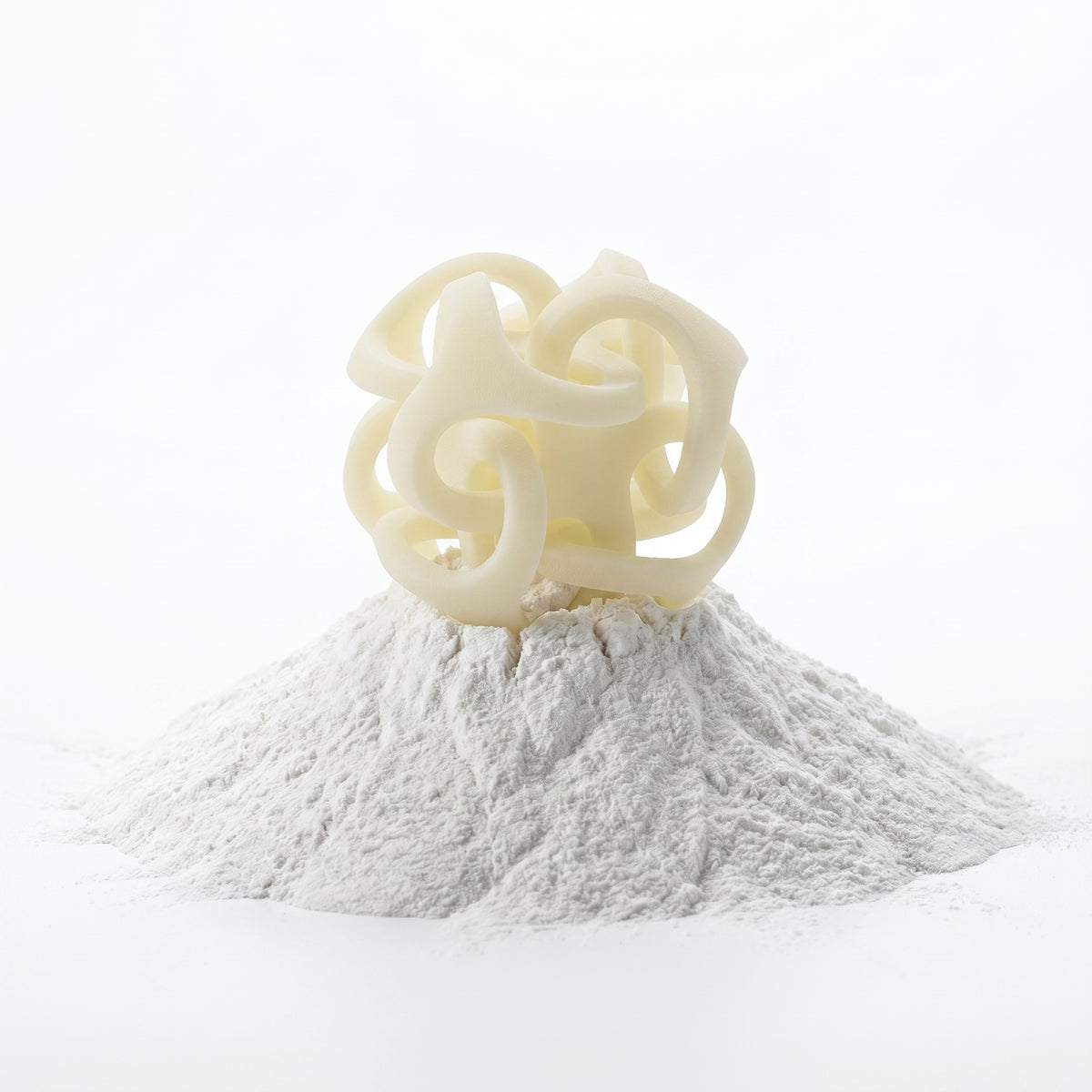
Pó Sinterit PA12 Industrial Powder

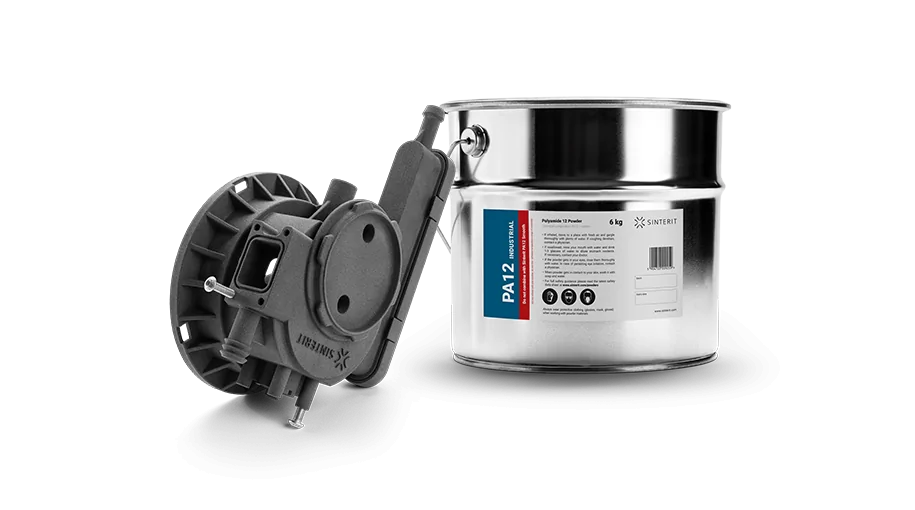
O que você precisa saber sobre este material
Sobre o material
A high resistance nylon 12 with very good dimensioning accuracy of prints It is the ratio of a minimum amount of fresh powder needed in a mixture of m
A high resistance nylon 12 with very good dimensioning accuracy of prints It is the ratio of a minimum amount of fresh powder needed in a mixture of material used in an SLS 3D printer. A lower refresh ratio means better cost-efficiency of the material. The amount of needed fresh powder is automatically calculated by our software and shown on the printer screen after the print job is finished. Just add shown amount of material into the mixing cycle of used material and you can start your next job with refreshed material. To start SLS 3D printing you need the powder starter pack. After that, you’ll only need to refresh the powder you own with fresh powder. PA12 Industrial is a high-resistance Nylon 12 SLS powder designed for Sinterit Lisa X and similar printers. It offers excellent mechanical strength, chemical resistance, dimensional accuracy, and biocompatibility, making it suitable for functional prototypes, jigs/fixtures, and end-use parts. The powder has a melting point of 184.4 °C. No nitrogen atmosphere is required for printing. With a mean particle size (D50) of ~62 µm and a bulk density of 505 kg/m³, this material ensures very good dimensional accuracy and stable print results. Yes. To maintain print quality, mix approximately 30 % fresh PA12 Industrial powder with 70 % recycled powder each cycle. Yes, it has been tested under ISO 10993 standards and found to be non-cytotoxic and non-irritant—but final use applications must be validated by the manufacturer. Officially approved for Sinterit Lisa X and SUZY printers. Perfect for functional prototypes, jigs/fixtures, end-use parts, chemically resistant components, and parts requiring high dimensional accuracy. The powder is medium-grey with a matte surface finish, producing industrial-quality aesthetics in finished parts. We have received the Suzy for printing and started it up with PA 11.5. The first prints turned out really well. But what’s huge is we reduced printing time for a full build space by more than fifty percent. Thank you very much for convincing me to make the switch from PA12. I believe that we will be able to quickly implement a new product line with PA11.5 by the end of the year. Sinterit’s Lisa X has allowed us to reduce lead-times and create better solutions — faster, helping us satisfy our customers. We have looked at other 3D printing methods, and other brands, but ultimately decided on SLS and chose Sinterit for their communication, and open material possibility. Something we couldn’t find in other suppliers of affordable entry level SLS printers. Getting Lisa X solved a lot of our problems. It has a big enough printing area, so we almost always can print big components in one part. It wouldn’t be possible with competitive SLS 3D printing solutions. The main reason Somfy reached out for the SLS technology from Sinterit was productivity. Printing many pieces in one batch was a game-changer When we look at Lisa’s line of printers, or Sinterit at general compared to other companies, the two major things that we liked were the materials, that are open source, so we are not locked into one brand […]. We are able to look around the market and use a material that works best for the part. Need a 3D Printer tailored for this purpose? Your concerns may include costs, ROI, customer support, print quality, or printing speed. We have helped thousands of companies make the right choice. The Administrator of your personal data is Sinterit Sp. z o.o. with its registered seat in Krakow, ul. Nad Drwina 10 bud. B3, 30-741 Krakow, entered in the register of entrepreneurs kept by the District Court for Krakow - Śródmieście in Kraków, XI Economic Division of the National Court Register under KRS number: 0000535095, tax identification number (NIP): 6793106416. Your personal data will be processed solely for the purpose of providing you with an answer to the enquiry sent via the contact form. The legal basis for the processing is your freely given consent (Article 6(1)(a) of the RODO/GDPR), which is necessary to fulfil the indicated purpose. Your data will be stored for the period necessary to respond or until you withdraw your consent. You may withdraw your given consent to the processing of your personal data at any time, which does not affect the lawfulness of the processing carried out on the basis of your consent before its withdrawal. In addition, you have the right to access, rectify, transfer, erase or restrict the processing of your data and to object to the processing. Detailed information regarding the processing of your personal data is contained in our Privacy Policy (click here). Save time and simplify the decision-making process when choosing a 3D printer tailored for your project. Your checklist is on its way — please check your inbox The Administrator of your personal data is Sinterit Sp. z o.o. with its registered seat in Krakow, ul. Nad Drwina 10 bud. B3, 30-741 Krakow, entered in the register of entrepreneurs kept by the District Court for Krakow – Śródmieście in Kraków, XI Economic Division of the National Court Register under KRS number: 0000535095, tax identification number (NIP): 6793106416. Your personal data will be processed solely for the purpose of providing you with an answer to the enquiry sent via the contact form. The legal basis for the processing is your freely given consent (Article 6(1)(a) of the RODO/GDPR), which is necessary to fulfil the indicated purpose. Your data will be stored for the period necessary to respond or until you withdraw your consent. You may withdraw your given consent to the processing of your personal data at any time, which does not affect the lawfulness of the processing carried out on the basis of your consent before its withdrawal. In addition, you have the right to access, rectify, transfer, erase or restrict the processing of your data and to object to the processing. Detailed information regarding the processing of your personal data is contained in our Privacy Policy ( click here ). more Start Solving Your Production Challenges. Get a tailored SLS solution that delivers quality, ROI & reliability – on your terms. Book a free consultation with our SLS Experts url: http://sinterit.com/wp-content/uploads/2025/04/PA12-Industrial.pdf local: PA12-Industrial.pdf FEATURES • very good dimensional accuracy • biocompatibile1 • excellent mechanical properties • high chemical resistance APPLICATIONS • final parts • functional prototypes • jigs and fixtures • parts with very good dimensioning www.sinterit.com Material’s Technical Data Sheet Compatible with: 1. Tested for non irritant, non cytotoxicity and not a sensitizer. When producing the 3D prints, it is the manufacturer’s responsibility to confirm the specifications for the final use. 2. Refresh ratio is the amount of refreshing powder that is required to be mixed after the printing with unsintered material. 3 Cubic test samples with sides of 3 cm. Information provided within this document are average values for reference and comparison only. All tests were performed with print samples from Lisa X printers. Parameters presented in this specification are subject to change without notice. Final part properties may vary based on printed part design, print orientation and material handling. General information Test method Material type Nylon 12 Software Sinterit Studio Basic Nitrogen needed No Refresh ratio2 30 % Colour grey mat Mean particle size D50 62 µm ISO 8130/13 Bulk density 505 kg/m3 ISO 60 Printout density 1.033 g/cm3 PN-EN ISO 845:2010 Printout water absorption 0.633 % PN-EN ISO 62:2008 PA12 Industrial A high resistance nylon 12 with very good dimensional accuracy of prints. Perfect for functional prototyping, jigs and fixtures and end use parts. www.sinterit.com 4. Tests were carried out in accordance with ISO 10993-1:2018. When producing the 3D prints, it is the manufacturer’s responsibility to confirm the specifications for the final use. Material properties may vary based on the design and manufacturing practices. 5. Roughness of test specimens surfaces printed with layer thickness of 125 [μm]. Information provided within this document are average values for reference and comparison only. All tests were performed with print samples from Lisa X printers. Parameters presented in this specification are subject to change without notice. Final part properties may vary based on printed part design, print orientation and material handling. Rev: 31-10-2022 Mechanical properties Test method Tensile Strength 52.3 MPa PN-EN ISO 527- 2:2012 Elongation at Break 7.8 MPa PN-EN ISO 527- 2:2012 Tensile Modulus 1840 MPa PN-EN ISO 527- 2:2012 Flexural Strength 60.6 MPa PN-EN ISO 178:2019 Flexural Modulus 1380 MPa PN-EN ISO 178:2019 Shore hardness in type D scale 75 PN- EN ISO 868:2005 Impact strength (Charpy method - unnotched) 29.5 kJ/m2 PN-EN ISO 179- 1/1eU:2010 Thermal properties Test method Melting point 184.4 °C PN-EN ISO 11357-3:2018 Biocompatibility Information4 Test method Description ISO 10993-5 non-cytotoxic ISO 10993-10 not a sensitizer ISO 10993-23 no irritant X Y Z ZX XY YX Surface roughness5 Print orientation Ra [um] Rz [um] Flat XY 11.203 68.016 Flat YX 14.210 86.486 Upright ZX 18.113 107.679 url: https://sinterit.com/wp-content/uploads/2024/03/EN_PA12INDUSTRIAL_LISAX_2024.pdf.pdf local: EN_PA12INDUSTRIAL_LISAX_2024.pdf.pdf General properties Test method Material Type Nylon 12 - Nitrogen needed No - Colour Grey mat - internal Refresh ratio2 30 % internal Bulk density 505 kg/m3 PN-EN ISO 60:2011 Printout density 0.99 g/cm3 PN-EN ISO 845:2010 Printout water absorption 0.22 % PN-EN ISO 62:2008 Mean particle size D50 62 µm ISO 13320 www.sinterit.com FEATURES • very good dimensional accuracy • biocompatibile1 • excellent mechanical properties • high chemical resistance APPLICATIONS • final parts • functional prototypes • jigs and fixtures • parts with very good dimensioning PA12 Industrial A high resistance nylon 12 with very good dimensional accuracy of prints. Perfect for functional prototyping, jigs and fixtures and end-use parts. TDS for Lisa X Material’s Technical Data Sheet Compatible with: www.sinterit.com 1. Tested for nonirritant, non-cytotoxicity, and not a sensitizer. When producing the 3D prints, it is the manufacturer’s responsibility to confirm the specifications for the final use. 2. Refresh ratio is the amount of refreshing powder that is required to be mixed after the printing with unsintered material. 3. Tests were carried out in accordance with ISO 10993-1:2018. When producing the 3D prints, it is the manufacturer’s responsibility to confirm the specifications for the final use. Material properties may vary based on the design and manufacturing practices. Information provided within this document are average values for reference and comparison only. All tests were performed with print samples from Lisa X printed from the fresh powder. Parameters presented in this specification are subject to change without notice. Final part properties may vary based on printed part design, print orientation, and material handling. All mechanical tests were carried out on samples conditioned to ISO standards at (23 ± 2)°C and (50 ± 5)% r. h. Rev. 19-03-2024 Mechanical properties Test method Tensile Strength (X direction) 47.61 MPa PN-EN ISO 527-1:2012 Tensile Strength (Y direction) 48.66 MPa PN-EN ISO 527-1:2012 Tensile Modulus (X direction) 2001 MPa PN-EN ISO 527-1:2012 Tensile Modulus (Y direction) 1983 MPa PN-EN ISO 527-1:2012 Elongation at Break (X direction) 5.86 % PN-EN ISO 527-1:2012 Elongation at Break (Y direction) 5.78 % PN-EN ISO 527-1:2012 Flexural Strength (X direction) 62.31 MPa PN-EN ISO 178:2019 Flexural Strength (Y direction) 57.55 MPa PN-EN ISO 178:2019 Flexural Modulus (X direction) 1791 MPa PN-EN ISO 178:2019 Flexural Modulus (Y direction) 1768 MPa PN-EN ISO 178:2019 Impact strength X (Charpy - unnotched) 15.23 kJ/m2 PN-EN ISO 179-1:2010 Impact strength Y (Charpy - unnotched) 22.92 kJ/m2 PN-EN ISO 179-1:2010 Shore Hardness in D scale 75 - PN-EN ISO 868:2005 Thermal properties Test method Melting temperature 184 °C PN-EN ISO 11357-3:2018 HDT A (X direction) 51 °C PN-EN ISO 75-2:2013-06 HDT A (Y direction) 53 °C PN-EN ISO 75-2:2013-06 HDT B (X direction) 159 °C PN-EN ISO 75-2:2013-06 HDT B (Y direction) 161 °C PN-EN ISO 75-2:2013-06 Softening point (Vicat A50) 165 °C PN-EN ISO 306:2014-02 Biocompatibility Information3 Test method Description ISO 10993-5 non-cytotoxic ISO 10993-10 not a sensitizer ISO 10993-23 no irritant url: https://sinterit.com/wp-content/uploads/2022/11/PA-12-Industrial_GB-en_10.pdf local: PA-12-Industrial_GB-en_10.pdf according to UK REACH Regulation Safety Data Sheet Sinterit Sp. z o. o. PA 12 Industrial Revision date: 13.10.2022 Product code: 14 Page 1 of 9 SECTION 1: Identification of the substance/mixture and of the company/undertaking PA 12 Industrial 1.1. Product identifier UFI (Unique Formula Identifier): 9710-10EA-U00J-3NMR Further trade names 1.2. Relevant identified uses of the substance or mixture and uses advised against Powder for 3D printing Use of the substance/mixture Any non-intended use. Uses advised against 1.3. Details of the supplier of the safety data sheet Sinterit Sp. z o. o.Company name: Street: Nad Drwina 10 bud. B3 Place: PL-30-741 Krakow Telephone: +48 570 697 854 contact@sinterit.come-mail: K. GlowackiContact person: E-Mail: contact@sinterit.com Sinterit sp. z o.o., Nad Drwina 10 bud. B3, 30-741 Krakow, Poland Responsible Department: Poison Information Center Mainz, Germany, Tel: +49 (6131) 192401.4. Emergency telephone number: SECTION 2: Hazards identification 2.1. Classification of the substance or mixture GB CLP Regulation This mixture is not classified as hazardous in accordance with GB CLP Regulation. 2.2. Label elements Additional advice on labelling Labelling according to GHS (UK CLP) regulation.: none For information or further instructions, see also section 11 or 12. No risks worthy of mention. Please observe the information on the safety data sheet at all times. 2.3. Other hazards SECTION 3: Composition/information on ingredients 3.2. Mixtures polyamides, additives The product does not contain dangerous substances according to UK REACH, Annex II, Part A, 3.1/3.2. that must be mentioned in Chapter 3. Chemical characterization Hazardous components none (according to UK REACH Regulation) Further Information Product does not contain listed SVHC substances > 0,1 % according to Regulation (EC) No. 1907/2006 Article 59 (REACH) Print date: 13.10.2022 GB - ENRevision No: 1,0 according to UK REACH Regulation Safety Data Sheet Sinterit Sp. z o. o. PA 12 Industrial Revision date: 13.10.2022 Product code: 14 Page 2 of 9 SECTION 4: First aid measures 4.1. Description of first aid measures In case of accident or unwellness, seek medical advice immediately (show directions for use or safety data sheet if possible). General information In case of accident by inhalation: remove casualty to fresh air and keep at rest. In case of respiratory tract irritation, consult a physician. After inhalation Gently wash with plenty of soap and water. In case of skin irritation, seek medical treatment. After contact with skin Rinse cautiously with water for several minutes. In case of troubles or persistent symptoms, consult an ophthalmologist. After contact with eyes Rinse mouth thoroughly with water. Let water be drunken in little sips (dilution effect). Do NOT induce vomiting. In all cases of doubt, or when symptoms persist, seek medical advice. After ingestion 4.2. Most important symptoms and effects, both acute and delayed No information available. 4.3. Indication of any immediate medical attention and special treatment needed Treat symptomatically. SECTION 5: Firefighting measures 5.1. Extinguishing media Carbon dioxide (CO2). Dry extinguishing powder. alcohol resistant foam. Atomized water. Suitable extinguishing media High power water jet. Unsuitable extinguishing media 5.2. Special hazards arising from the substance or mixture Can be released in case of fire: Carbon dioxide (CO2). Carbon monoxide (CO). Nitrogen oxides (NOx). 5.3. Advice for firefighters In case of fire: Wear self-contained breathing apparatus. Collect contaminated fire extinguishing water separately. Do not allow entering drains or surface water. Co-ordinate fire-fighting measures to the fire surroundings. Additional information SECTION 6: Accidental release measures 6.1. Personal precautions, protective equipment and emergency procedures Avoid dust formation. Do not breathe dust. General advice For non-emergency personnel Wear personal protection equipment (refer to section 8). For emergency responders No special measures are necessary. Discharge into the environment must be avoided. 6.2. Environmental precautions 6.3. Methods and material for containment and cleaning up Print date: 13.10.2022 GB - ENRevision No: 1,0 according to UK REACH Regulation Safety Data Sheet Sinterit Sp. z o. o. PA 12 Industrial Revision date: 13.10.2022 Product code: 14 Page 3 of 9 Take up mechanically. Treat the recovered material as prescribed in the section on waste disposal. For containment Clean contaminated objects and areas thoroughly observing environmental regulations. For cleaning up Safe handling: see section 7 Personal protection equipment: see section 8 Disposal: see section 13 6.4. Reference to other sections SECTION 7: Handling and storage 7.1. Precautions for safe handling Wear personal protection equipment (refer to section 8). Advice on safe handling Usual measures for fire prevention. Dust clouds may present an explosion hazard. Advice on protection against fire and explosion Always close containers tightly after the removal of product. Do not eat, drink, smoke or sneeze at the workplace. Wash hands before breaks and after work. Advice on general occupational hygiene Avoid generation of dust. General protection and hygiene measures: refer to chapter 8 Further information on handling 7.2. Conditions for safe storage, including any incompatibilities Keep container tightly closed in a cool, well-ventilated place. Requirements for storage rooms and vessels Do not store together with: Explosives. Oxidizing solids. Oxidizing liquids. Radioactive substances. Infectious substances. Food and animal feedingstuff. Hints on joint storage Keep the packing dry and well sealed to prevent contamination and absorbtion of humidity. Recommended storage temperature: 20°C Protect against: frost. UV-radiation/sunlight. heat. Humidity Further information on storage conditions 7.3. Specific end use(s) See section 1. SECTION 8: Exposure controls/personal protection 8.1. Control parameters To date, no national critical limit values exist. Additional advice on limit values 8.2. Exposure controls Technical measures and the application of suitable work processes have priority over personal protection equipment. Dust should be exhausted directly at the point of origin. Appropriate engineering controls Print date: 13.10.2022 GB - ENRevision No: 1,0 according to UK REACH Regulation Safety Data Sheet Sinterit Sp. z o. o. PA 12 Industrial Revision date: 13.10.2022 Product code: 14 Page 4 of 9 Individual protection measures, such as personal protective equipment Dust protection goggles. Eye/face protection In case of prolonged or frequently repeated skin contact: Wear suitable gloves. Suitable material: FKM (fluororubber). - Thickness of glove material: 0,4 mm Breakthrough time >= 8 h Butyl rubber. - Thickness of glove material: 0,5 mm Breakthrough time >= 8 h CR (polychloroprenes, Chloroprene rubber). - Thickness of glove material: 0,5 mm Breakthrough time >= 8 h NBR (Nitrile rubber). - Thickness of glove material: 0,35 mm Breakthrough time >= 8 h PVC (Polyvinyl chloride). - Thickness of glove material: 0,5 mm Breakthrough time >= 8 h The selected protective gloves have to satisfy the specifications of EU Directive EC/2016/425 and the standard EN ISO 374 derived from it. Before using check leak tightness / impermeability. In the case of wanting to use the gloves again, clean them before taking off and air them well. Hand protection Suitable protective clothing: Protective clothing. Minimum standard for preventive measures while handling with working materials are specified in the TRGS 500 (D). Skin protection With correct and proper use, and under normal conditions, breathing protection is not required. Respiratory protection necessary at: -Exceeding exposure limit values -Insufficient ventilation and Generation/formation of dust Suitable respiratory protective equipment: particulates filter device (DIN EN 143). Type: P1-3 The filter class must be suitable for the maximum contaminant concentration (gas/vapour/aerosol/particulates) that may arise when handling the product. If the concentration is exceeded, self-contained breathing apparatus must be used. Respiratory protection Thermal hazards Material handled at elevated temperature may cause thermal burns by contact with molten product. No special precautionary measures are necessary. Environmental exposure controls solidPhysical state: 9.1. Information on basic physical and chemical properties SECTION 9: Physical and chemical properties Colour: brown odorlessOdour: Changes in the physical state 180 - 190 °CMelting point/freezing point: not determinedBoiling point or initial boiling point and boiling range: not determinedSublimation point: not determinedSoftening point: not determinedPour point: Print date: 13.10.2022 GB - ENRevision No: 1,0 according to UK REACH Regulation Safety Data Sheet Sinterit Sp. z o. o. PA 12 Industrial Revision date: 13.10.2022 Product code: 14 Page 5 of 9 not determinedFlash point: Dust clouds may present an explosion hazard. Explosive properties not determinedLower explosion limits: not determinedUpper explosion limits: not determinedAuto-ignition temperature: Self-ignition temperature > 350 °CSolid: not determinedGas: > 350 °CDecomposition temperature: pH-Value: not determined Viscosity / dynamic: not determined Viscosity / kinematic: not determined Flow time: not applicable Water solubility: insoluble Solubility in other solvents not determined SECTION 12: Ecological informationPartition coefficient n-octanol/water: Vapour pressure: not determined Density: 0,45-0,55 g/cm³ 1,0 - 1,2Relative density (at 20 °C): Bulk density: not determined Relative vapour density: not applicable 9.2. Other information Information with regard to physical hazard classes Sustaining combustion: Not sustaining combustion none Oxidizing properties Other safety characteristics not applicableSolvent separation test: not determinedSolvent content: not determinedSolid content: Evaporation rate: not applicable Further Information No information available. SECTION 10: Stability and reactivity 10.1. Reactivity No information available. 10.2. Chemical stability The product is chemically stable under recommended conditions of storage, use and temperature. 10.3. Possibility of hazardous reactions No hazardous reaction when handled and stored according to provisions. Refer to chapter 10.5. Print date: 13.10.2022 GB - ENRevision No: 1,0 according to UK REACH Regulation Safety Data Sheet Sinterit Sp. z o. o. PA 12 Industrial Revision date: 13.10.2022 Product code: 14 Page 6 of 9 Protect against: UV-radiation/sunlight. heat. 10.4. Conditions to avoid Materials to avoid: Oxidizing agents, strong. Reducing agents, strong. 10.5. Incompatible materials Can be released in case of fire: Carbon dioxide (CO2). Carbon monoxide (CO). Nitrogen oxides (NOx). 10.6. Hazardous decomposition products SECTION 11: Toxicological information 11.1. Information on hazard classes as defined in GB CLP Regulation Toxicocinetics, metabolism and distribution No data available. Acute toxicity Based on available data, the classification criteria are not met. Based on available data, the classification criteria are not met. Irritation and corrosivity Sensitising effects Based on available data, the classification criteria are not met. Carcinogenic/mutagenic/toxic effects for reproduction Based on available data, the classification criteria are not met. STOT-single exposure Based on available data, the classification criteria are not met. Based on available data, the classification criteria are not met. STOT-repeated exposure Aspiration hazard Based on available data, the classification criteria are not met. No data available. Specific effects in experiment on an animal 11.2. Information on other hazards Endocrine disrupting properties No data available. SECTION 12: Ecological information 12.1. Toxicity The product has not been tested. 12.2. Persistence and degradability The product has not been tested. 12.3. Bioaccumulative potential No indication of bioaccumulation potential. No data available. 12.4. Mobility in soil 12.5. Results of PBT and vPvB assessment The substances in the mixture do not meet the PBT/vPvB criteria according to UK REACH. The aforementioned statement applies to substances contained in the product with a minimum content of 0.1 %. 12.6. Endocrine disrupting properties Print date: 13.10.2022 GB - ENRevision No: 1,0 according to UK REACH Regulation Safety Data Sheet Sinterit Sp. z o. o. PA 12 Industrial Revision date: 13.10.2022 Product code: 14 Page 7 of 9 This product does not contain a substance that has endocrine disrupting properties with respect to non-target organisms as no components meets the criteria. The aforementioned statement applies to substances contained in the product with a minimum content of 0.1 %. No data available. 12.7. Other adverse effects Do not allow to enter into surface water or drains. Further information SECTION 13: Disposal considerations 13.1. Waste treatment methods Disposal recommendations Observe in addition any national regulations! Consult the local waste disposal expert about waste disposal. Non-contaminated packages may be recycled. According to (EWC) European Waste Catalogue, allocation of waste identity numbers/waste descriptions must be carried out in a specific way for every industry and process. Control report for waste code/ waste marking according to (EWC) European Waste Catalogue: List of Wastes Code - residues/unused products 200139 MUNICIPAL WASTES (HOUSEHOLD WASTE AND SIMILAR COMMERCIAL, INDUSTRIAL AND INSTITUTIONAL WASTES) INCLUDING SEPARATELY COLLECTED FRACTIONS; separately collected fractions (except 15 01); Plastics List of Wastes Code - used product MUNICIPAL WASTES (HOUSEHOLD WASTE AND SIMILAR COMMERCIAL, INDUSTRIAL AND INSTITUTIONAL WASTES) INCLUDING SEPARATELY COLLECTED FRACTIONS; separately collected fractions (except 15 01); Plastics 200139 List of Wastes Code - contaminated packaging WASTE PACKAGING; ABSORBENTS, WIPING CLOTHS, FILTER MATERIALS AND PROTECTIVE CLOTHING NOT OTHERWISE SPECIFIED; packaging (including separately collected municipal packaging waste); mixed packaging 150106 Handle contaminated packages in the same way as the substance itself. Contaminated packaging SECTION 14: Transport information Land transport (ADR/RID) 14.1. UN number or ID number: No dangerous good in sense of this transport regulation. 14.2. UN proper shipping name: No dangerous good in sense of this transport regulation. 14.3. Transport hazard class(es): No dangerous good in sense of this transport regulation. 14.4. Packing group: No dangerous good in sense of this transport regulation. Inland waterways transport (ADN) 14.1. UN number or ID number: No dangerous good in sense of this transport regulation. 14.2. UN proper shipping name: No dangerous good in sense of this transport regulation. 14.3. Transport hazard class(es): No dangerous good in sense of this transport regulation. 14.4. Packing group: No dangerous good in sense of this transport regulation. Marine transport (IMDG) 14.1. UN number or ID number: No dangerous good in sense of this transport regulation. 14.2. UN proper shipping name: No dangerous good in sense of this transport regulation. 14.3. Transport hazard class(es): No dangerous good in sense of this transport regulation. 14.4. Packing group: No dangerous good in sense of this transport regulation. Air transport (ICAO-TI/IATA-DGR) 14.1. UN number or ID number: No dangerous good in sense of this transport regulation. Print date: 13.10.2022 GB - ENRevision No: 1,0 according to UK REACH Regulation Safety Data Sheet Sinterit Sp. z o. o. PA 12 Industrial Revision date: 13.10.2022 Product code: 14 Page 8 of 9 14.2. UN proper shipping name: No dangerous good in sense of this transport regulation. 14.3. Transport hazard class(es): No dangerous good in sense of this transport regulation. 14.4. Packing group: No dangerous good in sense of this transport regulation. 14.5. Environmental hazards NoENVIRONMENTALLY HAZARDOUS: 14.6. Special precautions for user Refer to section 6 - 8 14.7. Maritime transport in bulk according to IMO instruments not relevant SECTION 15: Regulatory information 15.1. Safety, health and environmental regulations/legislation specific for the substance or mixture EU regulatory information No information available.2010/75/EU (VOC): No information available.2004/42/EC (VOC): Information according to 2012/18/EU (SEVESO III): Not subject to 2012/18/EU (SEVESO III) Additional information Safety Data Sheet according to UK-REACH Regulation The mixture is classified as not hazardous according to regulation (EC) No 1272/2008 [CLP]. UK REACH Appendix XVII, No (mixture): not relevant National regulatory information - - non-hazardous to waterWater hazard class (D): 15.2. Chemical safety assessment For the following substances of this mixture a chemical safety assessment has been carried out: SECTION 16: Other information Changes Rev. 1.0; Initial release: 13.10.2022 Abbreviations and acronyms ADR: Accord européen sur le transport des marchandises dangereuses par Route (European Agreement concerning the International Carriage of Dangerous Goods by Road) CAS: Chemical Abstracts Service CLP: Classification, Labelling and Packaging of substances and mixtures DNEL: Derived No Effect Level d: day(s) EINECS: European INventory of Existing Commercial chemical Substances ELINCS: European LIst of Notified Chemical Substances ECHA: European Chemicals Agency EWC: European Waste Catalogue IARC: INTERNATIONAL AGENCY FOR RESEARCH ON CANCER IMDG: International Maritime Code for Dangerous Goods IATA: International Air Transport Association IATA-DGR: Dangerous Goods Regulations by the "International Air Transport Association" (IATA) ICAO: International Civil Aviation Organization ICAO-TI: Technical Instructions by the "International Civil Aviation Organization" (ICAO) GHS: Globally Harmonized System of Classification and Labelling of Chemicals GefStoffV: Gefahrstoffverordnung (Ordinance on Hazardous Substances, Germany) h: hour Print date: 13.10.2022 GB - ENRevision No: 1,0 according to UK REACH Regulation Safety Data Sheet Sinterit Sp. z o. o. PA 12 Industrial Revision date: 13.10.2022 Product code: 14 Page 9 of 9 LOAEL: Lowest observed adverse effect level LOAEC: Lowest observed adverse effect concentration LC50: Lethal concentration, 50 percent LD50: Lethal dose, 50 percent NOAEL: No observed adverse effect level NOAEC: No observed adverse effect concentration NLP: No-Longer Polymers N/A: not applicable OECD: Organisation for Economic Co-operation and Development PNEC: predicted no effect concentration PBT: Persistent bioaccumulative toxic RID: Reglement international concernant le transport des marchandises dangereuses par chemin de fer (Regulations Concerning the International Transport of Dangerous Goods by Rail ) REACH: Registration, Evaluation, Authorisation of Chemicals SVHC: substance of very high concern TRGS: Technische Regeln für Gefahrstoffe UN: United Nations VOC: Volatile Organic Compounds Classification according to GHS [UK CLP] - Classification procedure: Health hazards: Calculation method. Environmental hazards: Calculation method. Physical hazards: On basis of test data and / or calculated and / or estimated. The above information describes exclusively the safety requirements of the product and is based on our present-day knowledge. The information is intended to give you advice about the safe handling of the product named in this safety data sheet, for storage, processing, transport and disposal. The information cannot be transferred to other products. In the case of mixing the product with other products or in the case of processing, the information on this safety data sheet is not necessarily valid for the new made-up material. Further Information (The data for the hazardous ingredients were taken respectively from the last version of the sub-contractor's safety data sheet.) Print date: 13.10.2022 GB - ENRevision No: 1,0 url: https://sinterit.com/wp-content/uploads/2023/01/PA12-Industrial-3.pdf local: PA12-Industrial-3.pdf FEATURES • very good dimensional accuracy • biocompatibile1 • excellent mechanical properties • high chemical resistance APPLICATIONS • final parts • functional prototypes • jigs and fixtures • parts with very good dimensioning www.sinterit.com Material’s Technical Data Sheet Compatible with: 1. Tested for non irritant, non cytotoxicity and not a sensitizer. When producing the 3D prints, it is the manufacturer’s responsibility to confirm the specifications for the final use. 2. Refresh ratio is the amount of refreshing powder that is required to be mixed after the printing with unsintered material. 3 Cubic test samples with sides of 3 cm. Information provided within this document are average values for reference and comparison only. All tests were performed with print samples from Lisa X printers. Parameters presented in this specification are subject to change without notice. Final part properties may vary based on printed part design, print orientation and material handling. General information Test method Material type Nylon 12 Software Sinterit Studio Basic Nitrogen needed No Refresh ratio2 30 % Colour grey mat Mean particle size D50 62 µm ISO 8130/13 Bulk density 505 kg/m3 ISO 60 Printout density 1.033 g/cm3 PN-EN ISO 845:2010 Printout water absorption 0.633 % PN-EN ISO 62:2008 PA12 Industrial A high resistance nylon 12 with very good dimensional accuracy of prints. Perfect for functional prototyping, jigs and fixtures and end use parts. www.sinterit.com 4. Tests were carried out in accordance with ISO 10993-1:2018. When producing the 3D prints, it is the manufacturer’s responsibility to confirm the specifications for the final use. Material properties may vary based on the design and manufacturing practices. 5. Roughness of test specimens surfaces printed with layer thickness of 125 [μm]. Information provided within this document are average values for reference and comparison only. All tests were performed with print samples from Lisa X printers. Parameters presented in this specification are subject to change without notice. Final part properties may vary based on printed part design, print orientation and material handling. Rev: 31-10-2022 Mechanical properties Test method Tensile Strength 52.3 MPa PN-EN ISO 527- 2:2012 Elongation at Break 7.8 MPa PN-EN ISO 527- 2:2012 Tensile Modulus 1840 MPa PN-EN ISO 527- 2:2012 Flexural Strength 60.6 MPa PN-EN ISO 178:2019 Flexural Modulus 1380 MPa PN-EN ISO 178:2019 Shore hardness in type D scale 75 PN- EN ISO 868:2005 Impact strength (Charpy method - unnotched) 29.5 kJ/m2 PN-EN ISO 179- 1/1eU:2010 Thermal properties Test method Melting point 184.4 °C PN-EN ISO 11357-3:2018 Biocompatibility Information4 Test method Description ISO 10993-5 non-cytotoxic ISO 10993-10 not a sensitizer ISO 10993-23 no irritant X Y Z ZX XY YX Surface roughness5 Print orientation Ra [um] Rz [um] Flat XY 11.203 68.016 Flat YX 14.210 86.486 Upright ZX 18.113 107.679 url: https://sinterit.com/wp-content/uploads/2022/11/PA-12-Industrial_D-de_10.pdf local: PA-12-Industrial_D-de_10.pdf gemäß Verordnung (EG) Nr. 1907/2006 Sicherheitsdatenblatt Sinterit Sp. z o. o. PA 12 Industrial Überarbeitet am: 13.10.2022 Materialnummer: 14 Seite 1 von 10 ABSCHNITT 1: Bezeichnung des Stoffs beziehungsweise des Gemischs und des Unternehmens PA 12 Industrial 1.1. Produktidentifikator UFI (Eindeutiger Rezepturidentifikator): 9710-10EA-U00J-3NMR Weitere Handelsnamen 1.2. Relevante identifizierte Verwendungen des Stoffs oder Gemischs und Verwendungen, von denen abgeraten wird Pulver für den 3D-Druck Verwendung des Stoffs/des Gemischs Jede nicht bestimmungsgemäße Verwendung. Verwendungen, von denen abgeraten wird 1.3. Einzelheiten zum Lieferanten, der das Sicherheitsdatenblatt bereitstellt Sinterit Sp. z o. o.Firmenname: Straße: Nad Drwina 10 bud. B3 Ort: PL-30-741 Krakow Telefon: +48 570 697 854 contact@sinterit.comE-Mail: K. GlowackiAnsprechpartner: E-Mail: contact@sinterit.com Sinterit sp. z o.o., Nad Drwina 10 bud. B3, 30-741 Krakow, Poland Auskunftgebender Bereich: Giftinformationszentrum Mainz - Tel: +49 (6131) 192401.4. Notrufnummer: ABSCHNITT 2: Mögliche Gefahren 2.1. Einstufung des Stoffs oder Gemischs Verordnung (EG) Nr. 1272/2008 Dieses Gemisch ist nicht als gefährlich eingestuft im Sinne der Verordnung (EG) Nr. 1272/2008. 2.2. Kennzeichnungselemente Hinweis zur Kennzeichnung Kennzeichnung gemäß Verordnung (EG) Nr. 1272/2008 [CLP]: keine/keiner Für Informationen oder weitergehende Hinweise siehe auch Abschnitt 11 oder 12. Keine besonders zu erwähnenden Gefahren. Bitte beachten Sie in jedem Fall die Informationen des Sicherheitsdatenblattes. 2.3. Sonstige Gefahren ABSCHNITT 3: Zusammensetzung/Angaben zu Bestandteilen 3.2. Gemische Polyamid, Additive Das Produkt enthält keine gefährlichen Stoffe, die aufgrund von VERORDNUNG (EU) Nr. 2020/878 DER KOMMISSION, Anhang II, Teil A, 3.1/3.2 in Kapitel 3 genannt werden müssen. Chemische Charakterisierung Gefährliche Inhaltsstoffe keine/keiner (gemäß Verordnung (EG) Nr. 1907/2006 (REACH)) Weitere Angaben Das Produkt enthält keine gelisteten SVHC Stoffe > 0,1% gemäß Verordnung (EG) Nr. 1907/2006 § 59 (REACH). Druckdatum: 13.10.2022 D - DERevisions-Nr.: 1,0 gemäß Verordnung (EG) Nr. 1907/2006 Sicherheitsdatenblatt Sinterit Sp. z o. o. PA 12 Industrial Überarbeitet am: 13.10.2022 Materialnummer: 14 Seite 2 von 10 ABSCHNITT 4: Erste-Hilfe-Maßnahmen 4.1. Beschreibung der Erste-Hilfe-Maßnahmen Bei Unfall oder Unwohlsein sofort Arzt hinzuziehen (wenn möglich, Betriebsanweisung oder Sicherheitsdatenblatt vorzeigen). Allgemeine Hinweise Bei Unfall durch Einatmen: Verunfallten an die frische Luft bringen und ruhigstellen. Bei Reizung der Atemwege Arzt aufsuchen. Nach Einatmen Behutsam mit viel Wasser und Seife waschen. Bei Hautreizungen Arzt aufsuchen. Nach Hautkontakt Einige Minuten lang behutsam mit Wasser ausspülen. Bei auftretenden oder anhaltenden Beschwerden Augenarzt aufsuchen. Nach Augenkontakt Mund gründlich mit Wasser ausspülen. Reichlich Wasser in kleinen Schlucken trinken lassen (Verdünnungseffekt). KEIN Erbrechen herbeiführen. Bei Auftreten von Symptomen oder in Zweifelsfällen ärztlichen Rat einholen. Nach Verschlucken 4.2. Wichtigste akute und verzögert auftretende Symptome und Wirkungen Es liegen keine Informationen vor. 4.3. Hinweise auf ärztliche Soforthilfe oder Spezialbehandlung Symptomatische Behandlung. ABSCHNITT 5: Maßnahmen zur Brandbekämpfung 5.1. Löschmittel Kohlendioxid (CO2). Trockenlöschmittel. alkoholbeständiger Schaum. Sprühwasser. Geeignete Löschmittel Wasservollstrahl. Ungeeignete Löschmittel 5.2. Besondere vom Stoff oder Gemisch ausgehende Gefahren Im Brandfall können entstehen: Kohlendioxid (CO2). Kohlenmonoxid (CO). Stickoxide (NOx). 5.3. Hinweise für die Brandbekämpfung Im Brandfall: Umgebungsluftunabhängiges Atemschutzgerät verwenden. Kontaminiertes Löschwasser getrennt sammeln. Nicht in die Kanalisation oder Gewässer gelangen lassen. Löschmaßnahmen auf die Umgebung abstimmen. Zusätzliche Hinweise ABSCHNITT 6: Maßnahmen bei unbeabsichtigter Freisetzung 6.1. Personenbezogene Vorsichtsmaßnahmen, Schutzausrüstungen und in Notfällen anzuwendende Verfahren Staubentwicklung vermeiden. Staub nicht einatmen. Allgemeine Hinweise Nicht für Notfälle geschultes Personal Persönliche Schutzausrüstung tragen (siehe Abschnitt 8). Einsatzkräfte Es sind keine besonderen Maßnahmen erforderlich. Druckdatum: 13.10.2022 D - DERevisions-Nr.: 1,0 gemäß Verordnung (EG) Nr. 1907/2006 Sicherheitsdatenblatt Sinterit Sp. z o. o. PA 12 Industrial Überarbeitet am: 13.10.2022 Materialnummer: 14 Seite 3 von 10 Ein Eintrag in die Umwelt ist zu vermeiden. 6.2. Umweltschutzmaßnahmen 6.3. Methoden und Material für Rückhaltung und Reinigung Mechanisch aufnehmen. Das aufgenommene Material gemäß Abschnitt Entsorgung behandeln. Für Rückhaltung Verschmutzte Gegenstände und Flächen unter Beachtung der Umweltvorschriften gründlich reinigen. Für Reinigung Sichere Handhabung: siehe Abschnitt 7 Persönliche Schutzausrüstung: siehe Abschnitt 8 Entsorgung: siehe Abschnitt 13 6.4. Verweis auf andere Abschnitte ABSCHNITT 7: Handhabung und Lagerung 7.1. Schutzmaßnahmen zur sicheren Handhabung Persönliche Schutzausrüstung tragen (siehe Abschnitt 8). Hinweise zum sicheren Umgang Übliche Maßnahmen des vorbeugenden Brandschutzes. Staubwolken können eine Explosionsgefahr darstellen. Hinweise zum Brand- und Explosionsschutz Behälter nach Produktentnahme immer dicht verschliessen. Am Arbeitsplatz nicht essen, trinken, rauchen, schnupfen. Vor den Pausen und bei Arbeitsende Hände waschen. Hinweise zu allgemeinen Hygienemaßnahmen am Arbeitsplatz Staubentwicklung vermeiden. Schutz- und Hygienemaßnahmen: siehe Kapitel 8 Weitere Angaben zur Handhabung 7.2. Bedingungen zur sicheren Lagerung unter Berücksichtigung von Unverträglichkeiten Behälter dicht geschlossen halten und an einem kühlen, gut gelüfteten Ort aufbewahren. Anforderungen an Lagerräume und Behälter Nicht zusammen lagern mit: Explosivstoffe. Entzündend (oxidierend) wirkende feste Stoffe. Entzündend (oxidierend) wirkende flüssige Stoffe. Radioaktive Stoffe. Ansteckungsgefährliche Stoffe. Nahrungs- und Futtermittel. Zusammenlagerungshinweise Die Verpackung trocken und gut verschlossen halten, um Verunreinigung und Absorption von Feuchtigkeit zu vermeiden. Empfohlene Lagerungstemperatur: 20°C Schützen gegen: Frost. UV-Einstrahlung/Sonnenlicht. Hitze. Feuchtigkeit Weitere Angaben zu den Lagerbedingungen 10-13Lagerklasse nach TRGS 510: 7.3. Spezifische Endanwendungen Siehe Abschnitt 1. ABSCHNITT 8: Begrenzung und Überwachung der Exposition/Persönliche Schutzausrüstungen 8.1. Zu überwachende Parameter Arbeitsplatzgrenzwerte (TRGS 900) Spitzenbegr.F/m³mg/m³ppmBezeichnungCAS-Nr. Art Druckdatum: 13.10.2022 D - DERevisions-Nr.: 1,0 gemäß Verordnung (EG) Nr. 1907/2006 Sicherheitsdatenblatt Sinterit Sp. z o. o. PA 12 Industrial Überarbeitet am: 13.10.2022 Materialnummer: 14 Seite 4 von 10 Allgemeiner Staubgrenzwert, alveolengängige Fraktion - 1,25 A 2(II)Allgemeiner Staubgrenzwert, einatembare Fraktion - 10 E 8.2. Begrenzung und Überwachung der Exposition Technische Maßnahmen und die Anwendung geeigneter Arbeitsverfahren haben Vorrang vor dem Einsatz persönlicher Schutzausrüstungen. Staub sollte unmittelbar am Entstehungsort abgesaugt werden. Geeignete technische Steuerungseinrichtungen Individuelle Schutzmaßnahmen, zum Beispiel persönliche Schutzausrüstung Staubschutzbrille. Augen-/Gesichtsschutz Bei längerem oder oftmals wiederholtem Hautkontakt: Geeignete Schutzhandschuhe tragen. Geeignetes Material: FKM (Fluorkautschuk). - Dicke des Handschuhmaterials: 0,4 mm Durchbruchszeit: >= 8 h Butylkautschuk. - Dicke des Handschuhmaterials: 0,5 mm Durchbruchszeit: >= 8 h CR (Polychloropren, Chloroprenkautschuk). - Dicke des Handschuhmaterials: 0,5 mm Durchbruchszeit: >= 8 h NBR (Nitrilkautschuk). - Dicke des Handschuhmaterials: 0,35 mm Durchbruchszeit: >= 8 h PVC (Polyvinylchlorid). - Dicke des Handschuhmaterials: 0,5 mm Durchbruchszeit: >= 8 h Die einzusetzenden Handschuhe müssen den Spezifikationen der EG-Verordnung (EU) 2016/425 und der sich daraus ergebenden Norm EN ISO 374 genügen. Vor Gebrauch auf Dichtheit / Undurchlässigkeit überprüfen. Bei beabsichtigter Wiederverwendung Handschuhe vor dem Ausziehen reinigen und gut durchlüftet aufbewahren. Handschutz Geeigneter Körperschutz: Schutzkleidung. Mindeststandards für Schutzmaßnahmen beim Umgang mit Arbeitsstoffen sind in der TRGS 500 aufgeführt. Körperschutz Bei sachgemäßer Verwendung und unter normalen Bedingungen ist ein Atemschutz nicht erforderlich. Atemschutz ist erforderlich bei: -Grenzwertüberschreitung -Unzureichender Belüftung und Stauberzeugung/-bildung Geeignetes Atemschutzgerät: Partikelfiltergerät (DIN EN 143). Filtertyp: P1-3 Die Atemschutzfilterklasse ist unbedingt der maximalen Schadstoffkonzentration (Gas/Dampf/Aerosol/Partikel) anzupassen, die beim Umgang mit dem Produkt entstehen kann. Bei Konzentrationsüberschreitung muss Isoliergerät benutzt werden! Die Tragezeitbegrenzungen nach GefStoffV in Verbindung mit den Regeln für den Einsatz von Atemschutzgeräten (BGR 190) sind zu beachten. Atemschutz Thermische Gefahren Bei hohen Temperaturen gehandhabtes Material kann durch Kontakt mit dem geschmolzenen Material Verbrennungen verursachen. Es sind keine besonderen Vorsichtsmaßnahmen erforderlich. Begrenzung und Überwachung der Umweltexposition Druckdatum: 13.10.2022 D - DERevisions-Nr.: 1,0 gemäß Verordnung (EG) Nr. 1907/2006 Sicherheitsdatenblatt Sinterit Sp. z o. o. PA 12 Industrial Überarbeitet am: 13.10.2022 Materialnummer: 14 Seite 5 von 10 festAggregatzustand: 9.1. Angaben zu den grundlegenden physikalischen und chemischen Eigenschaften ABSCHNITT 9: Physikalische und chemische Eigenschaften Farbe: braun geruchslosGeruch: Zustandsänderungen 180 - 190 °CSchmelzpunkt/Gefrierpunkt: nicht bestimmtSiedepunkt oder Siedebeginn und Siedebereich: nicht bestimmtSublimationstemperatur: nicht bestimmtErweichungspunkt: nicht bestimmtPourpoint: nicht bestimmtFlammpunkt: Staubwolken können eine Explosionsgefahr darstellen. Explosionsgefahren nicht bestimmtUntere Explosionsgrenze: nicht bestimmtObere Explosionsgrenze: nicht bestimmtZündtemperatur: Selbstentzündungstemperatur > 350 °CFeststoff: nicht bestimmtGas: > 350 °CZersetzungstemperatur: pH-Wert: nicht bestimmt Dynamische Viskosität: nicht bestimmt Kinematische Viskosität: nicht bestimmt Auslaufzeit: nicht anwendbar Wasserlöslichkeit: unlöslich Löslichkeit in anderen Lösungsmitteln nicht bestimmt ABSCHNITT 12: Umweltbezogene AngabenVerteilungskoeffizient n-Oktanol/Wasser: Dampfdruck: nicht bestimmt Dichte: 0,45-0,55 g/cm³ 1,0 - 1,2Relative Dichte (bei 20 °C): Schüttdichte: nicht bestimmt Relative Dampfdichte: nicht anwendbar 9.2. Sonstige Angaben Angaben über physikalische Gefahrenklassen Weiterbrennbarkeit: Keine selbstunterhaltende Verbrennung keine/keiner Oxidierende Eigenschaften Sonstige sicherheitstechnische Kenngrößen nicht anwendbarLösemitteltrennprüfung: nicht bestimmtLösemittelgehalt: Druckdatum: 13.10.2022 D - DERevisions-Nr.: 1,0 gemäß Verordnung (EG) Nr. 1907/2006 Sicherheitsdatenblatt Sinterit Sp. z o. o. PA 12 Industrial Überarbeitet am: 13.10.2022 Materialnummer: 14 Seite 6 von 10 nicht bestimmtFestkörpergehalt: Verdampfungsgeschwindigkeit: nicht anwendbar Weitere Angaben Es liegen keine Informationen vor. ABSCHNITT 10: Stabilität und Reaktivität 10.1. Reaktivität Es liegen keine Informationen vor. 10.2. Chemische Stabilität Das Produkt ist unter den empfohlenen Lagerungs-, Verwendungs- und Temperaturbedingungen chemisch stabil. 10.3. Möglichkeit gefährlicher Reaktionen Bei bestimmungsgemäßer Handhabung und Lagerung treten keine gefährlichen Reaktionen auf. Siehe Kapitel 10.5. Schützen gegen: UV-Einstrahlung/Sonnenlicht. Hitze. 10.4. Zu vermeidende Bedingungen Zu vermeidende Stoffe: Oxidationsmittel, stark. Reduktionsmittel, stark. 10.5. Unverträgliche Materialien Im Brandfall können entstehen: Kohlendioxid (CO2). Kohlenmonoxid (CO). Stickoxide (NOx). 10.6. Gefährliche Zersetzungsprodukte ABSCHNITT 11: Toxikologische Angaben 11.1. Angaben zu den Gefahrenklassen im Sinne der Verordnung (EG) Nr. 1272/2008 Toxikokinetik, Stoffwechsel und Verteilung Keine Daten verfügbar. Akute Toxizität Aufgrund der verfügbaren Daten sind die Einstufungskriterien nicht erfüllt. Aufgrund der verfügbaren Daten sind die Einstufungskriterien nicht erfüllt. Reiz- und Ätzwirkung Sensibilisierende Wirkungen Aufgrund der verfügbaren Daten sind die Einstufungskriterien nicht erfüllt. Krebserzeugende, erbgutverändernde und fortpflanzungsgefährdende Wirkungen Aufgrund der verfügbaren Daten sind die Einstufungskriterien nicht erfüllt. Spezifische Zielorgan-Toxizität bei einmaliger Exposition Aufgrund der verfügbaren Daten sind die Einstufungskriterien nicht erfüllt. Aufgrund der verfügbaren Daten sind die Einstufungskriterien nicht erfüllt. Spezifische Zielorgan-Toxizität bei wiederholter Exposition Aspirationsgefahr Aufgrund der verfügbaren Daten sind die Einstufungskriterien nicht erfüllt. Keine Daten verfügbar. Spezifische Wirkungen im Tierversuch 11.2. Angaben über sonstige Gefahren Endokrinschädliche Eigenschaften Keine Daten verfügbar. ABSCHNITT 12: Umweltbezogene Angaben Druckdatum: 13.10.2022 D - DERevisions-Nr.: 1,0 gemäß Verordnung (EG) Nr. 1907/2006 Sicherheitsdatenblatt Sinterit Sp. z o. o. PA 12 Industrial Überarbeitet am: 13.10.2022 Materialnummer: 14 Seite 7 von 10 12.1. Toxizität Das Produkt wurde nicht geprüft. 12.2. Persistenz und Abbaubarkeit Das Produkt wurde nicht geprüft. 12.3. Bioakkumulationspotenzial Kein Hinweis auf Bioakkumulationspotential. Keine Daten verfügbar. 12.4. Mobilität im Boden 12.5. Ergebnisse der PBT- und vPvB-Beurteilung Die Stoffe im Gemisch erfüllen nicht die PBT/vPvB Kriterien gemäß REACH, Anhang XIII. Die voranstehende Aussage gilt für die in dem Produkt enthaltenen Stoffe ab 0,1 %. Dieses Produkt enthält keinen Stoff, der gegenüber Nichtzielorganismen endokrine Eigenschaften aufweist, da kein Inhaltstoff die Kriterien erfüllt. Die voranstehende Aussage gilt für die in dem Produkt enthaltenen Stoffe ab 0,1 %. 12.6. Endokrinschädliche Eigenschaften Keine Daten verfügbar. 12.7. Andere schädliche Wirkungen Nicht in die Kanalisation oder Gewässer gelangen lassen. Weitere Hinweise ABSCHNITT 13: Hinweise zur Entsorgung 13.1. Verfahren der Abfallbehandlung Empfehlungen zur Entsorgung Die nationalen Rechtsvorschriften sind zusätzlich zu beachten! Wegen einer Abfallentsorgung den zuständigen zugelassenen Entsorger ansprechen. Nicht kontaminierte und restentleerte Verpackungen können einer Wiederverwertung zugeführt werden. Die Zuordnung der Abfallschlüsselnummern/Abfallbezeichnungen ist entsprechend EAKV branchen- und prozessspezifisch durchzuführen. Vorschlagsliste für Abfallschlüssel/Abfallbezeichnungen gemäß EAKV/AVV: Abfallschlüssel - ungebrauchtes Produkt 200139 SIEDLUNGSABFÄLLE (HAUSHALTSABFÄLLE UND ÄHNLICHE GEWERBLICHE UND INDUSTRIELLE ABFÄLLE SOWIE ABFÄLLE AUS EINRICHTUNGEN), EINSCHLIESSLICH GETRENNT GESAMMELTER FRAKTIONEN; Getrennt gesammelte Fraktionen (außer 15 01); Kunststoffe Abfallschlüssel - verbrauchtes Produkt SIEDLUNGSABFÄLLE (HAUSHALTSABFÄLLE UND ÄHNLICHE GEWERBLICHE UND INDUSTRIELLE ABFÄLLE SOWIE ABFÄLLE AUS EINRICHTUNGEN), EINSCHLIESSLICH GETRENNT GESAMMELTER FRAKTIONEN; Getrennt gesammelte Fraktionen (außer 15 01); Kunststoffe 200139 Abfallschlüssel - ungereinigte Verpackung VERPACKUNGSABFALL, AUFSAUGMASSEN, WISCHTÜCHER, FILTERMATERIALIEN UND SCHUTZKLEIDUNG (A.N.G.); Verpackungen (einschließlich getrennt gesammelter kommunaler Verpackungsabfälle); gemischte Verpackungen 150106 Kontaminierte Verpackungen sind wie der Stoff zu behandeln. Entsorgung ungereinigter Verpackung und empfohlene Reinigungsmittel ABSCHNITT 14: Angaben zum Transport Landtransport (ADR/RID) 14.1. UN-Nummer oder ID-Nummer: Kein Gefahrgut im Sinne dieser Transportvorschriften. Druckdatum: 13.10.2022 D - DERevisions-Nr.: 1,0 gemäß Verordnung (EG) Nr. 1907/2006 Sicherheitsdatenblatt Sinterit Sp. z o. o. PA 12 Industrial Überarbeitet am: 13.10.2022 Materialnummer: 14 Seite 8 von 10 14.2. Ordnungsgemäße UN-Versandbezeichnung: Kein Gefahrgut im Sinne dieser Transportvorschriften. 14.3. Transportgefahrenklassen: Kein Gefahrgut im Sinne dieser Transportvorschriften. 14.4. Verpackungsgruppe: Kein Gefahrgut im Sinne dieser Transportvorschriften. Binnenschiffstransport (ADN) 14.1. UN-Nummer oder ID-Nummer: Kein Gefahrgut im Sinne dieser Transportvorschriften. 14.2. Ordnungsgemäße UN-Versandbezeichnung: Kein Gefahrgut im Sinne dieser Transportvorschriften. 14.3. Transportgefahrenklassen: Kein Gefahrgut im Sinne dieser Transportvorschriften. 14.4. Verpackungsgruppe: Kein Gefahrgut im Sinne dieser Transportvorschriften. Seeschiffstransport (IMDG) 14.1. UN-Nummer oder ID-Nummer: Kein Gefahrgut im Sinne dieser Transportvorschriften. 14.2. Ordnungsgemäße UN-Versandbezeichnung: Kein Gefahrgut im Sinne dieser Transportvorschriften. 14.3. Transportgefahrenklassen: Kein Gefahrgut im Sinne dieser Transportvorschriften. 14.4. Verpackungsgruppe: Kein Gefahrgut im Sinne dieser Transportvorschriften. Lufttransport (ICAO-TI/IATA-DGR) 14.1. UN-Nummer oder ID-Nummer: Kein Gefahrgut im Sinne dieser Transportvorschriften. 14.2. Ordnungsgemäße UN-Versandbezeichnung: Kein Gefahrgut im Sinne dieser Transportvorschriften. 14.3. Transportgefahrenklassen: Kein Gefahrgut im Sinne dieser Transportvorschriften. 14.4. Verpackungsgruppe: Kein Gefahrgut im Sinne dieser Transportvorschriften. 14.5. Umweltgefahren NeinUMWELTGEFÄHRDEND: 14.6. Besondere Vorsichtsmaßnahmen für den Verwender Siehe Abschnitt 6 - 8 14.7. Massengutbeförderung auf dem Seeweg gemäß IMO-Instrumenten nicht relevant ABSCHNITT 15: Rechtsvorschriften 15.1. Vorschriften zu Sicherheit, Gesundheits- und Umweltschutz/spezifische Rechtsvorschriften für den Stoff oder das Gemisch EU-Vorschriften Es liegen keine Informationen vor.Angaben zur IE-Richtlinie 2010/75/EU (VOC): Es liegen keine Informationen vor.Angaben zur VOC-Richtlinie 2004/42/EG: Angaben zur SEVESO III-Richtlinie 2012/18/EU: Unterliegt nicht der SEVESO III-Richtlinie Zusätzliche Hinweise Sicherheitsdatenblatt gemäß Verordnung (EG) Nr. 1907/2006 (geändert durch Verordnung (EU) Nr. 2020/878) Das Gemisch ist als nicht gefährlich eingestuft im Sinne der Verordnung (EG) Nr. 1272/2008 [CLP]. REACH 1907/2006 Anhang XVII, Nr. (Gemisch): nicht relevant Nationale Vorschriften 5.2.1: Gesamtstaub, einschließlich Feinstaub bei 0,2 < m <= 0,4 kg/h: Konz. 20 mg/m³ bzw. bei m <= 0,2 kg/h: Konz. 0,15 g/m³ bzw bei m > 0,4 kg/h: Konz. 10 mg/m³ Technische Anleitung Luft I: nicht bestimmtAnteil: - - nicht wassergefährdendWassergefährdungsklasse: Druckdatum: 13.10.2022 D - DERevisions-Nr.: 1,0 gemäß Verordnung (EG) Nr. 1907/2006 Sicherheitsdatenblatt Sinterit Sp. z o. o. PA 12 Industrial Überarbeitet am: 13.10.2022 Materialnummer: 14 Seite 9 von 10 Einstufung von Gemischen gemäß Anlage 1, Nr. 5 AwSVStatus: 15.2. Stoffsicherheitsbeurteilung Eine Stoffsicherheitsbeurteilung wurde für folgende Stoffe in diesem Gemisch durchgeführt: ABSCHNITT 16: Sonstige Angaben Änderungen Rev. 1.0; Neuerstellung: 13.10.2022 Abkürzungen und Akronyme ADR: Accord européen sur le transport des marchandises dangereuses par Route (Europäisches Übereinkommen über die internationale Beförderung gefährlicher Güter auf der Straße) AwSV: Verordnung über Anlagen zum Umgang mit wassergefährdenden Stoffen AVV: Abfallverzeichnisverordnung CAS: Chemical Abstracts Service CLP: Classification, Labelling and Packaging of substances and mixtures DNEL: Derived No Effect Level d: day(s) EAKV: Europäisches Abfallverzeichnis gemäß Entwurf Abfallverzeichnisverordnung EINECS: European INventory of Existing Commercial chemical Substances ELINCS: European LIst of Notified Chemical Substances ECHA: European Chemicals Agency EWC: European Waste Catalogue IARC: INTERNATIONAL AGENCY FOR RESEARCH ON CANCER IMDG: International Maritime Code for Dangerous Goods IATA: International Air Transport Association IATA-DGR: Dangerous Goods Regulations by the "International Air Transport Association" (IATA) ICAO: International Civil Aviation Organization ICAO-TI: Technical Instructions by the "International Civil Aviation Organization" (ICAO) GHS: Globally Harmonized System of Classification and Labelling of Chemicals GefStoffV: Gefahrstoffverordnung (Ordinance on Hazardous Substances, Germany) h: hour LOAEL: Lowest observed adverse effect level LOAEC: Lowest observed adverse effect concentration LC50: Lethal concentration, 50 percent LD50: Lethal dose, 50 percent NOAEL: No observed adverse effect level NOAEC: No observed adverse effect concentration NLP: No-Longer Polymers N/A: not applicable OECD: Organisation for Economic Co-operation and Development PNEC: predicted no effect concentration PBT: Persistent bioaccumulative toxic RID: Reglement international concernant le transport des marchandises dangereuses par chemin de fer (Regulations Concerning the International Transport of Dangerous Goods by Rail ) REACH: Registration, Evaluation, Authorisation of Chemicals SVHC: substance of very high concern TRGS: Technische Regeln für Gefahrstoffe UN/NU: United Nations (Vereinte Nationen) VOC: Volatile Organic Compounds VwVwS: Verwaltungsvorschrift wassergefaehrdender Stoffe WGK: Wassergefaehrdungsklasse Einstufung gemäß Verordnung (EG) Nr. 1272/2008 [CLP] - Einstufungsverfahren: Weitere Angaben Druckdatum: 13.10.2022 D - DERevisions-Nr.: 1,0 gemäß Verordnung (EG) Nr. 1907/2006 Sicherheitsdatenblatt Sinterit Sp. z o. o. PA 12 Industrial Überarbeitet am: 13.10.2022 Materialnummer: 14 Seite 10 von 10 Gesundheitsgefahren: Berechnungsverfahren. Umweltgefahren: Berechnungsverfahren. Physikalische Gefahren: Auf Basis von Prüfdaten und / oder berechnet und / oder geschätzt. Die Angaben in diesem Sicherheitsdatenblatt entsprechen nach bestem Wissen unseren Erkenntnissen bei Drucklegung. Die Informationen sollen Ihnen Anhaltspunkte für den sicheren Umgang mit dem in diesem Sicherheitsdatenblatt genannten Produkt bei Lagerung, Verarbeitung, Transport und Entsorgung geben. Die Angaben sind nicht übertragbar auf andere Produkte. Soweit das Produkt mit anderen Materialien vermengt, vermischt oder verarbeitet wird, oder einer Bearbeitung unterzogen wird, können die Angaben in diesem Sicherheitsdatenblatt, soweit sich hieraus nicht ausdrücklich etwas anderes ergibt, nicht auf das so gefertigte neue Material übertragen werden. (Die Daten der gefährlichen Inhaltsstoffe wurden jeweils dem letztgültigen Sicherheitsdatenblatt des Vorlieferanten entnommen.) Druckdatum: 13.10.2022 D - DERevisions-Nr.: 1,0 url: https://sinterit.com/wp-content/uploads/2022/11/PA-12-Industrial_PL-pl_10.pdf local: PA-12-Industrial_PL-pl_10.pdf zgodnie z rozporządzeniem (WE) nr 1907/2006 Karta charakterystyki Sinterit Sp. z o. o. PA 12 Industrial Data aktualizacji: 13.10.2022 Numer materiału: 14 Strona 1 z 10 SEKCJA 1: Identyfikacja substancji/mieszaniny i identyfikacja przedsiębiorstwa PA 12 Industrial 1.1. Identyfikator produktu UFI (niepowtarzalny identyfikator postaci czynnej): 9710-10EA-U00J-3NMR Inne nazwa handlowa 1.2. Istotne zidentyfikowane zastosowania substancji lub mieszaniny oraz zastosowania odradzane Proszek do druku 3D Zastosowanie substancji/mieszaniny Wszelkie niezgodne z przeznaczeniem użycia produktu. Zastosowania, których się nie zaleca 1.3. Dane dotyczące dostawcy karty charakterystyki Sinterit Sp. z o. o.Nazwa firmy: Ulica: Nad Drwina 10 bud. B3 Miejscowość: PL-30-741 Krakow Telefon: +48 570 697 854 contact@sinterit.come-mail: K. GlowackiOsoba do kontaktu: E-Mail: contact@sinterit.com Sinterit sp. z o.o., Nad Drwina 10 bud. B3, 30-741 Krakow, Poland Wydział Odpowiedzialny: Poison Information Center Mainz, Germany, Tel: +49 (6131) 192401.4. Numer telefonu alarmowego: SEKCJA 2: Identyfikacja zagrożeń 2.1. Klasyfikacja substancji lub mieszaniny Rozporządzenie (WE) nr 1272/2008 Mieszanina nie została zaklasyfikowana jako niebezpieczna zgodnie z rozporządzenia (WE) nr 1272/2008. 2.2. Elementy oznakowania Informacje dodatkowe Oznakowanie zgodnie z rozporządzeniem (WE) nr. 1272/2008 [CLP]: żadne/żaden Informacje lub dalsze wskazówki znajdują się również w rozdziale 11 lub 12. Brak wartych do wymienienia zagrożeń. Proszę przestrzegać w każdym wypadku informacji arkusza o zachowaniu ostrożności. 2.3. Inne zagrożenia SEKCJA 3: Skład/informacja o składnikach 3.2. Mieszaniny poliamid, dodatki Produkt nie zawiera żadnych materiałów niebezpiecznych, które powinny być wymienione z nazwy zgodnie z ROZPORZĄDZENIEM (UE) Nr 2020/878 KOMISJI Załącznik II Część A, 3.1/3.2. Rozdział 3. Charakterystyka chemiczna Składniki niebezpieczne brak/żaden (zgodnie z rozporządzeniem (WE) nr 1907/2006 (REACH)) Informacja uzupełniająca Produkt nie zawiera wymienione substancje SVHC > 0,1% odpowiedni Rozporządzenie (WE) nr 1907/2006 §59 (REACH) Wydrukowano dnia: 13.10.2022 PLWersja nr: 1,0 zgodnie z rozporządzeniem (WE) nr 1907/2006 Karta charakterystyki Sinterit Sp. z o. o. PA 12 Industrial Data aktualizacji: 13.10.2022 Numer materiału: 14 Strona 2 z 10 SEKCJA 4: Środki pierwszej pomocy 4.1. Opis środków pierwszej pomocy W przypadku awarii lub jezeli zle sie poczujesz, niezwlocznie zasiegnij porady lekarza - jezeli to mozliwe, pokaz etykiete. Wskazówki ogólne W przypadku zatrucia drogą oddechową wyprowadzić lub wynieść poszkodowanego na świeże powietrze i zapewnić warunki do odpoczynku. Przy podrażnieniu dróg oddechowych należy wezwać lekarza. W przypadku wdychania Delikatnie umyć dużą ilością wody z mydłem. Należy udać się do dermatologa. W przypadku kontaktu ze skórą Ostrożnie płukać wodą przez kilka minut. W przypadku wystąpienia dolegliwości należy udać się do okulisty. W przypadku kontaktu z oczami Jamę ustną przepłukać dokładnie wodą. Podać do wypicia dużą ilość wody w małych łykach (efekt rozcieńczenia). NIE wywoływać wymiotów. Przy wystąpieniu objawów lub w razie wątpliwości zasięgnąć porady lekarza. W przypadku połknięcia 4.2. Najważniejsze ostre i opóźnione objawy oraz skutki narażenia Nie istnieją żadne informacje. 4.3. Wskazania dotyczące wszelkiej natychmiastowej pomocy lekarskiej i szczególnego postępowania z poszkodowanym Badanie symptomatyczne. SEKCJA 5: Postępowanie w przypadku pożaru 5.1. Środki gaśnicze Dwutlenek węgla (CO2). Suche środki gaśnicze. piana na bazie alkoholi. Woda w sprayu. Odpowiednie środki gaśnicze Pełny strumień wody. Niewłaściwe środki gaśnicze 5.2. Szczególne zagrożenia związane z substancją lub mieszaniną Podczas pożaru mogą powstawać: Dwutlenek węgla (CO2). Tlenek węgla. Tlenki azotu (NOx). 5.3. Informacje dla straży pożarnej W razie pożaru: Stosować niezależny sprzęt do ochrony dróg oddechowych. Zanieczyszczoną wodę zbierać osobno. Nie powinna się ona dostać do kanalizacji lub zbiorników wodnych. Środki gaśnicze należy dostosować do otoczenia. Informacja uzupełniająca SEKCJA 6: Postępowanie w przypadku niezamierzonego uwolnienia do środowiska 6.1. Indywidualne środki ostrożności, wyposażenie ochronne i procedury w sytuacjach awaryjnych Unikać rozprzestrzeniania się kurzu. Nie wdychać pyłu. Ogólne wskazówki Dla osób nienależących do personelu udzielającego pomocy Używać osobistego wyposażenia ochronnego (patrz sekcja 8). Dla osób udzielających pomocy Nie wymaga się specjalnych środków. Należy unikać dostania się do środowiska. 6.2. Środki ostrożności w zakresie ochrony środowiska Wydrukowano dnia: 13.10.2022 PLWersja nr: 1,0 zgodnie z rozporządzeniem (WE) nr 1907/2006 Karta charakterystyki Sinterit Sp. z o. o. PA 12 Industrial Data aktualizacji: 13.10.2022 Numer materiału: 14 Strona 3 z 10 6.3. Metody i materiały zapobiegające rozprzestrzenianiu się skażenia i służące do usuwania skażenia Zebrać mechanicznie. Zebrany materiał traktować zgodnie z ustępem usunięcie. W celu hermetyzacji Zabrudzone przedmioty i podłogę gruntownie wyczyścić uwzgledniając przepisy ochrony srodowiska. Do czyszczenia Bezpieczna obsługa: patrz Dział 7 Środki ochrony indywidualnej: patrz Dział 8 Usunięcie odpadów: patrz Dział 13 6.4. Odniesienia do innych sekcji SEKCJA 7: Postępowanie z substancjami i mieszaninami oraz ich magazynowanie 7.1. Środki ostrożności dotyczące bezpiecznego postępowania Używać osobistego wyposażenia ochronnego (patrz sekcja 8). Wskazówki odnośnie bezpiecznego obchodzenia się z substancją Ogólnie przyjęte środki zapobiegawcze ochrony przeciwpożarowej. Chmury pylu moga stwarzac zagrozenie wybuchem. Wskazówki na wypadek pożaru i wybuchu Po pobraniu produktu należy zawsze dokładnie zamykać pojemnik. W miejscu pracy nie wolno jeść, pić lub zażywać tabaki. Myć ręce przed przerwami w pracy i na jej zakończenie. Zalecenia dotyczące ogólnej higieny pracy Unikać rozprzestrzeniania się kurzu. Środki higieny i ochrony: patrz rozdział 8 Informacja uzupełniająca 7.2. Warunki bezpiecznego magazynowania, w tym informacje dotyczące wszelkich wzajemnych niezgodności Pojemniki przechowywać szczelnie zamknięte w chłodnym, dobrze wentylowanym miejscu. Wymagania względem pomieszczeń i pojemników magazynowych Nie magazynować razem z: Substancje wybuchowe. Zapalnie (utleniająco) działające substancje stałe. Zapalnie (utleniająco) działające substancje ciekłe. Substancji radioaktywnych. Substancji zakaźnych. Środki żywnościowe i paszowe. Wskazówki do składowania kolektywnego Opakowanie przechowywać sucho i dobrze zamknięte, aby uniknąć zanieczyszczenia i absorbcji wilgoci. Zalecana temperatura magazynowania: 20°C Chronić przed: mróz. Promieniowanie UV/światło słoneczne. gorąco. Wilgotność Inne informacje o warunkach przechowywania 7.3. Szczególne zastosowanie(-a) końcowe Patrz sekcja 1. SEKCJA 8: Kontrola narażenia/środki ochrony indywidualnej 8.1. Parametry dotyczące kontroli Dotychczas nie ustalono żadnych krajowych norm granicznych. Inne informacje dotyczące dopuszczalnych wartości narażenia 8.2. Kontrola narażenia Wydrukowano dnia: 13.10.2022 PLWersja nr: 1,0 zgodnie z rozporządzeniem (WE) nr 1907/2006 Karta charakterystyki Sinterit Sp. z o. o. PA 12 Industrial Data aktualizacji: 13.10.2022 Numer materiału: 14 Strona 4 z 10 Srodki techniczne i zastosowanie odpowiednich procesów pracowniczych są ważniejsze niż użycie osobistego wyposażenia ochronnego. Pył i osad powinien zastać zebrany bezpośrednio w miejscu powstania. Stosowne techniczne środki kontroli Indywidualne środki ochrony takie jak indywidualne wyposażenie ochronne Okulary chroniące przed pyłem. Ochrona oczu lub twarzy Przy długim lub często powtarzającym się kontacie ze skórą: Nosić odpowiednie rękawice ochronne. Właściwy materiał: FKM (kauczuk fluorowy). - Grubość materiału rękawic: 0,4 mm Czas przenikania: >= 8 h Kauczuk butylowy. - Grubość materiału rękawic: 0,5 mm Czas przenikania: >= 8 h CR (polichloropren, kauczuk chloroprenowy, polichloropren). - Grubość materiału rękawic: 0,5 mm Czas przenikania: >= 8 h NBR (Nitrylokauczuk). - Grubość materiału rękawic: 0,35 mm Czas przenikania: >= 8 h PVC (Chlorek poliwynylu). - Grubość materiału rękawic: 0,5 mm Czas przenikania: >= 8 h Wybrane rękawice ochronne muszą spełniać specyfikację dyrektywy 2016/425/UE i normy pochodnej EN 374. Przed użyciem przetestować na szczelność / nieszczelność. Przy zamiarze ponownego użycia rękawic przed zdjęciem wyczyścić i przechowywać w miejscu o dobrej cyrkulacji powietrza. Ochrona rąk Właściwa odzież ochronna: Odzież ochronna. Minimalne standardy dla środków ochronnych przy obchodzeniu się substancjami w miejscu pracy wymienione są w TRG S 500 (D). Ochrona skóry przy właściwym użytkowaniu i w normalnych warunkach ochrona dróg oddechowych nie jest konieczna. Ochrona dróg oddechowych jest wymagana przy: -Przekroczenie wartości dopuszczalnej -Niewystarczającej wentylacji i Wytwarzanie/tworzenie się pyłu Właściwa ochrona dróg oddechowych: cząstkowe urządzenie filtrujące (EN 143). Typ: P1-3 Klasę filtra ochrony dróg oddechowych należy koniecznie dopasować do maksymalnego stężenia substancji szkodliwych (gaz/opary/aerozol/cząsteczki), które może powstawać przy obchodzeniu się z produktem. Jeśli stężenie jest przekroczone, należy stosować izolowany aparat oddechowy! Ochrona dróg oddechowych Zagrożenia termiczne Obsługa materiału o wysokiej temperaturze grozi oparzeniami w wyniku zetknięcia się z roztopionym produktem. Nie są wymagane żadne dodatkowe środki ostrożności. Kontrola narażenia środowiska stałyStan fizyczny: 9.1. Informacje na temat podstawowych właściwości fizycznych i chemicznych SEKCJA 9: Właściwości fizyczne i chemiczne Kolor: brązowy bezwonnyZapach: Zmiana stanu 180 - 190 °CTemperatura topnienia/krzepnięcia: Wydrukowano dnia: 13.10.2022 PLWersja nr: 1,0 zgodnie z rozporządzeniem (WE) nr 1907/2006 Karta charakterystyki Sinterit Sp. z o. o. PA 12 Industrial Data aktualizacji: 13.10.2022 Numer materiału: 14 Strona 5 z 10 nieokreślonyTemperatura wrzenia lub początkowa temperatura wrzenia i zakres temperatur wrzenia: nieokreślonyTemperatura sublimacji: nieokreślonyTemperatura mięknięcia: nieokreślonyPunkt pour: nieokreślonyTemperatura zapłonu: Chmury pylu moga stwarzac zagrozenie wybuchem. Właściwości wybuchowe nieokreślonyGranice wybuchowości - dolna: nieokreślonyGranice wybuchowości - górna: nieokreślonyTemperatura samozapłonu: Temperatura samozapłonu > 350 °Cciała stałego: nieokreślonygazu: > 350 °CTemperatura rozkładu: pH: nieokreślony Lepkość dynamiczna: nieokreślony Lepkość kinematyczna: nieokreślony Czas wypływu: nie dotyczy Rozpuszczalność w wodzie: nierozpuszczalny Rozpuszczalność w innych rozpuszczalnikach nieokreślony SEKCJA 12: Informacje ekologiczneWspółczynnik podziału n-oktanol/woda: Prężność par: nieokreślony Gęstość: 0,45-0,55 g/cm³ 1,0 - 1,2Gęstość względna (przy 20 °C): Gęstość usypowa: nieokreślony Względna gęstość pary: nie dotyczy 9.2. Inne informacje Informacje dotyczące klas zagrożenia fizycznego Kontynuowana palność: Samo nieutrzymywalne spalanie żadne/żaden Właściwości utleniające Inne właściwości bezpieczeństwa nie dotyczyBadanie na oddzielenie rozpuszczalnika: nieokreślonyZawartość rozpuszczalnika: nieokreślonyZawartość ciała stałego: Szybkość odparowywania względna: nie dotyczy Informacja uzupełniająca Nie istnieją żadne informacje. SEKCJA 10: Stabilność i reaktywność Wydrukowano dnia: 13.10.2022 PLWersja nr: 1,0 zgodnie z rozporządzeniem (WE) nr 1907/2006 Karta charakterystyki Sinterit Sp. z o. o. PA 12 Industrial Data aktualizacji: 13.10.2022 Numer materiału: 14 Strona 6 z 10 10.1. Reaktywność Nie istnieją żadne informacje. 10.2. Stabilność chemiczna Produkt jest stabliny chemicznie w zalecanych warunkach przechowywania, stosowania i temperatury. 10.3. Możliwość występowania niebezpiecznych reakcji W przypadku użytkowania i magazynowania zgodnie z przeznaczeniem nie występują reakcje niebezpieczne. Patrz rozdział 10.5. Chronić przed: Promieniowanie UV/światło słoneczne. gorąco. 10.4. Warunki, których należy unikać Czynniki, których należy unikać: Środek utleniający, silny. Środek redukujący, silny. 10.5. Materiały niezgodne Podczas pożaru mogą powstawać: Dwutlenek węgla (CO2). Tlenek węgla. Tlenki azotu (NOx). 10.6. Niebezpieczne produkty rozkładu SEKCJA 11: Informacje toksykologiczne 11.1. Informacje na temat klas zagrożenia zdefiniowanych w rozporządzeniu (WE) nr 1272/2008 Toksykokinetyka, metabolizm i rozmieszczenie Brak danych. Toksyczność ostra W oparciu o dostępne dane, kryteria klasyfikacji nie są spełnione. W oparciu o dostępne dane, kryteria klasyfikacji nie są spełnione. Działanie drażniące i żrące Działanie uczulające W oparciu o dostępne dane, kryteria klasyfikacji nie są spełnione. Rakotwórczość, mutagenność, działanie szkodliwe na rozrodczość W oparciu o dostępne dane, kryteria klasyfikacji nie są spełnione. Działanie toksyczne na narządy docelowe - narażenie jednorazowe W oparciu o dostępne dane, kryteria klasyfikacji nie są spełnione. W oparciu o dostępne dane, kryteria klasyfikacji nie są spełnione. Działanie toksyczne na narządy docelowe - narażenie powtarzane Zagrożenie spowodowane aspiracją W oparciu o dostępne dane, kryteria klasyfikacji nie są spełnione. Brak danych. Specyficzne działanie w próbie na zwierzętach 11.2 Informacje o innych zagrożeniach Właściwości zaburzające funkcjonowanie układu hormonalnego Brak danych. SEKCJA 12: Informacje ekologiczne 12.1. Toksyczność Produkt nie został przetestowany. 12.2. Trwałość i zdolność do rozkładu Produkt nie został przetestowany. 12.3. Zdolność do bioakumulacji Brak wskazówek na potencjał bioakumulacyjny. Brak danych. 12.4. Mobilność w glebie Wydrukowano dnia: 13.10.2022 PLWersja nr: 1,0 zgodnie z rozporządzeniem (WE) nr 1907/2006 Karta charakterystyki Sinterit Sp. z o. o. PA 12 Industrial Data aktualizacji: 13.10.2022 Numer materiału: 14 Strona 7 z 10 12.5. Wyniki oceny właściwości PBT i vPvB Substancje zawarte w mieszaninie nie spełniają kryteriów PBT/vPvB zgodnie z załącznikiem XIII do rozporządzenia REACH Powyższe stwierdzenie dotyczy substancji zawartych w produkcie od 0,1%. Produkt nie zawiera substancji o właściwościach zaburzających funkcjonowanie układu hormonalnego w odniesieniu do organizmów innych niż zwalczane, ponieważ żaden z jego składników nie spełnia odnośnych kryteriów. Powyższe stwierdzenie dotyczy substancji zawartych w produkcie od 0,1%. 12.6. Właściwości zaburzające funkcjonowanie układu hormonalnego Brak danych. 12.7. Inne szkodliwe skutki działania Nie odprowadzać do kanalizacji i zbiorników wodnych. Informacja uzupełniająca SEKCJA 13: Postępowanie z odpadami 13.1. Metody unieszkodliwiania odpadów Zalecenia Należy dodatkowo stosawać się do krajowych przepisów i rozporządzeń! W celu usunięcia odpadów zwrócić się do kompetentnych zarejestrowanych słuzb komunalnych. Opakowania nie mające kontaktu z chemikaliami, dokładnie opróżnione i oczyszczone, mogą być użyte ponownie. Zaszeregowanie kluczowych numerów odpadków/oznaczeń odpadków należy przeprowadzić zgodnie z rozporządzeniem o wprowadzeniu Europejskiego Katalogu Odpadków specyficznie dla branży i procesu. Proponowana lista kluczowych pojęć oznaczeń odpadów zgodnie z Europejskim Katalogiem Odpadów EWC: Kod odpadów - pozostałości po produkcie / niewykorzystany produkt 200139 ODPADY KOMUNALNE (ODPADY Z GOSPODARSTW DOMOWYCH ORAZ PODOBNE ODPADY HANDLOWE, PRZEMYSŁOWE I INSTYTUCJONALNE) ŁĄCZNIE Z FRAKCJAMI GROMADZONYMI SELEKTYWNIE; frakcje gromadzone selektywnie (z wyjątkiem 15 01); tworzywa sztuczne Kod odpadów - wykorzystany produkt ODPADY KOMUNALNE (ODPADY Z GOSPODARSTW DOMOWYCH ORAZ PODOBNE ODPADY HANDLOWE, PRZEMYSŁOWE I INSTYTUCJONALNE) ŁĄCZNIE Z FRAKCJAMI GROMADZONYMI SELEKTYWNIE; frakcje gromadzone selektywnie (z wyjątkiem 15 01); tworzywa sztuczne 200139 Kod odpadów - zanieczyszczone opakowanie ODPADY OPAKOWANIOWE; SORBENTY, TKANINY DO WYCIERANIA, MATERIAŁY FILTRACYJNE I UBRANIA OCHRONNE NIEUJĘTE W INNYCH GRUPACH; odpady opakowaniowe (włączając w to oddzielnie gromadzone komunalne odpady opakowaniowe); zmieszane odpady opakowaniowe 150106 Zużyte opakowania są traktowane jako tworzywo. Usuwanie zanieczyszczonych opakowań i zalecane środki czyszczące SEKCJA 14: Informacje dotyczące transportu Transport lądowy (ADR/RID) 14.1. Numer UN lub numer identyfikacyjny ID: Towar nie jest klasyfikowany jako niebezpieczny w świetle przepisów transportowych. 14.2. Prawidłowa nazwa przewozowa UN: Towar nie jest klasyfikowany jako niebezpieczny w świetle przepisów transportowych. 14.3. Klasa(-y) zagrożenia w transporcie: Towar nie jest klasyfikowany jako niebezpieczny w świetle przepisów transportowych. Wydrukowano dnia: 13.10.2022 PLWersja nr: 1,0 zgodnie z rozporządzeniem (WE) nr 1907/2006 Karta charakterystyki Sinterit Sp. z o. o. PA 12 Industrial Data aktualizacji: 13.10.2022 Numer materiału: 14 Strona 8 z 10 14.4. Grupa pakowania: Towar nie jest klasyfikowany jako niebezpieczny w świetle przepisów transportowych. Transport wodny śródlądowy (ADN) 14.1. Numer UN lub numer identyfikacyjny ID: Towar nie jest klasyfikowany jako niebezpieczny w świetle przepisów transportowych. 14.2. Prawidłowa nazwa przewozowa UN: Towar nie jest klasyfikowany jako niebezpieczny w świetle przepisów transportowych. 14.3. Klasa(-y) zagrożenia w transporcie: Towar nie jest klasyfikowany jako niebezpieczny w świetle przepisów transportowych. 14.4. Grupa pakowania: Towar nie jest klasyfikowany jako niebezpieczny w świetle przepisów transportowych. Transport morski (IMDG) 14.1. Numer UN lub numer identyfikacyjny ID: Towar nie jest klasyfikowany jako niebezpieczny w świetle przepisów transportowych. 14.2. Prawidłowa nazwa przewozowa UN: Towar nie jest klasyfikowany jako niebezpieczny w świetle przepisów transportowych. 14.3. Klasa(-y) zagrożenia w transporcie: Towar nie jest klasyfikowany jako niebezpieczny w świetle przepisów transportowych. 14.4. Grupa pakowania: Towar nie jest klasyfikowany jako niebezpieczny w świetle przepisów transportowych. Transport lotniczy (ICAO-TI/IATA-DGR) 14.1. Numer UN lub numer identyfikacyjny ID: Towar nie jest klasyfikowany jako niebezpieczny w świetle przepisów transportowych. 14.2. Prawidłowa nazwa przewozowa UN: Towar nie jest klasyfikowany jako niebezpieczny w świetle przepisów transportowych. 14.3. Klasa(-y) zagrożenia w transporcie: Towar nie jest klasyfikowany jako niebezpieczny w świetle przepisów transportowych. 14.4. Grupa pakowania: Towar nie jest klasyfikowany jako niebezpieczny w świetle przepisów transportowych. 14.5. Zagrożenia dla środowiska NieZAGRAŻAJĄCY ŚRODOWISKU: 14.6. Szczególne środki ostrożności dla użytkowników patrz rozdział 6 - 8 14.7. Transport morski luzem zgodnie z instrumentami IMO bez znaczenia SEKCJA 15: Informacje dotyczące przepisów prawnych 15.1. Przepisy prawne dotyczące bezpieczeństwa, zdrowia i ochrony środowiska specyficzne dla substancji lub mieszaniny Informacje dotyczące przepisów UE Nie istnieją żadne informacje.Zawartość lotnych związków organicznych (LZO) zgodnie z Dyrektywą 2010/75/UE: Nie istnieją żadne informacje.Zawartość lotnych związków organicznych (LZO) zgodnie z Dyrektywą 2004/42/WE: Dane do wytycznych 2012/18/UE (SEVESO III): Nie podlega 2012/18/UE (SEVESO III) Informacja uzupełniająca Karta charakterystyki odpowiedni Rozporządzenie (WE) nr 1907/2006 (zmienione rozporządzeniem (UE) nr Wydrukowano dnia: 13.10.2022 PLWersja nr: 1,0 zgodnie z rozporządzeniem (WE) nr 1907/2006 Karta charakterystyki Sinterit Sp. z o. o. PA 12 Industrial Data aktualizacji: 13.10.2022 Numer materiału: 14 Strona 9 z 10 2020/878) Mieszanina nie została sklaysfikowana jako niebezpieczna zgodnie z rozporządzeniem (WE) NR 1272/2008 [CLP]. REACH 1907/2006 załącznik XVII No. (mieszanina): bez znaczenia Przepisy narodowe - - nie zagrażający wodomKlasa zagrożenia wód (D): Informacja uzupełniająca Rozporządzenie (WE) nr 1907/2006 Parlamentu Europejskiego i Rady z dnia 18 grudnia 2006 r. w sprawie rejestracji, oceny, udzielania zezwoleń i stosowanych ograniczeń w zakresie chemikaliów (REACH), utworzenia Europejskiej Agencji Chemikaliów, Rozporządzenie (WE) nr 1272/2008 Parlamentu Europejskiego i Rady z dnia 16 grudnia 2008 r. w sprawie klasyfikacji, oznakowania i pakowania substancji i mieszanin (CLP), zmieniające i uchylające dyrektywy 67/548/EWG i 1999/45/WE oraz zmieniające rozporządzenie (WE) nr 1907/2006. Rozporządzenie (UE) Nr 453/2010 Komisji z dnia 20 maja 2010 zmieniające rozporządzenie (WE) nr 1907/2006 Parlamentu Europejskiego i Rady w sprawie rejestracji, oceny, udzielania zezwoleń i stosownych ograniczeń w zakresie chemikaliów (REACH). Rozporządzenie (UE) 2015/830 z dnia 28 maja 2015r. zmieniające rozporządzenie (WE) nr 1907/2006 Parlamentu Europejskiego i Rady w sprawie rejestracji, oceny, udzielania zezwoleń i stosowanych ograniczeń w zakresie chemikaliów (REACH) ( Dziennik Urzędowy Unii Europejskiej z dnia 31.12.2008, Nr L 353/1 z późn. zmianą). Rozporządzenie Ministra Pracy i Polityki Socjalnej z dnia 26 września 1997r. w sprawie ogólnych przepisów bezpieczeństwa i higieny pracy (t.j. Dz.U. z 2003 r. Nr 169, poz. 1650 z późn. zm.) Rozporządzenie Ministra Zdrowia z dnia 24 lioca 2012 r. w sprawie substancji chemicznych, ich mieszanin, czynników lub procesów technologicznych o działaniu rakotwórczym lub mutagennym w środowisku pracy (t.j. Dz.U. z 2016r. poz. 1117) Rozporządzenie Ministra Pracy i Polityki Społecznej z dnia 6 czerwca 2014r. w sprawie najwyższych dopuszczalnych stężeń i natężeń czynników szkodliwych dla zdrowia w środowisku pracy (Dz. U. z 2014r. poz.817 z późn. zm.) Rozporządzenia Ministra Zdrowia z dnia 11 czerwca 2012r. w sprawie kategorii substancji niebezpiecznych, których opakowania wyposaża się w zamknięcia utrudniające otwarcie przez dzieci i wyczuwalne dotykiem ostrzeżenie o niebezpieczeństwie (t.j. Dz.U. z 2014r. poz. 1604) Ustawa z dnia 25 lutego 2011r. o substancjach chemicznych i ich mieszaninach (t.j. Dz.U. z 2015r. poz. 1203 z późn. zm.) Rozporządzenie Ministra Zdrowia z dnia 25 sierpnia 2015r. w sprawie sposobu oznakowania miejsc, rurociągów oraz pojemników i zbiorników służących do przechowywania lub zawierających substancje niebezpieczne lub mieszaniny niebezpieczne (Dz. U. z 2015r., poz. 1368) Ustawa z dn. 28 października 2002r. o przewozie drogowym towarów niebezpiecznych (Dz. U. Nr 199, poz.1671 z późniejszymi zmianami) Rozporządzenie Ministra Zdrowia z dnia 2 lutego 2011r. w sprawie badań i pomiarów czynników szkodliwych dla zdrowia w środowisku pracy (Dz. U. z 2011r., Nr 33, poz.166). Rozporządzenie Ministra Zdrowia z dnia 30 grudnia 2004r. w sprawie bezpieczeństwa i higieny pracy związanej z występowaniem w miejscu pracy czynników chemicznych ( t.j. Dz. U. z 2016r. poz. 1488 15.2. Ocena bezpieczeństwa chemicznego Przeprowadzono ocenę bezpieczeństwa dla następujących substancji w tej mieszaninie: SEKCJA 16: Inne informacje Zmiany Rev. 1.0; Pierwsze wersja: 13.10.2022 Skróty i akronimy ADR: Accord européen sur le transport des marchandises dangereuses par Route (międzynarodowa konwencja dotycząca drogowego przewozu towarów i ładunków niebezpiecznych) CAS: Chemical Abstracts Service CLP: Classification, Labelling and Packaging of substances and mixtures Wydrukowano dnia: 13.10.2022 PLWersja nr: 1,0 zgodnie z rozporządzeniem (WE) nr 1907/2006 Karta charakterystyki Sinterit Sp. z o. o. PA 12 Industrial Data aktualizacji: 13.10.2022 Numer materiału: 14 Strona 10 z 10 DNEL: Derived No Effect Level d: day(s) EINECS: European INventory of Existing Commercial chemical Substances ELINCS: European LIst of Notified Chemical Substances ECHA: European Chemicals Agency EWC: European Waste Catalogue IARC: INTERNATIONAL AGENCY FOR RESEARCH ON CANCER IMDG: International Maritime Code for Dangerous Goods IATA: International Air Transport Association IATA-DGR: Dangerous Goods Regulations by the "International Air Transport Association" (IATA) ICAO: International Civil Aviation Organization ICAO-TI: Technical Instructions by the "International Civil Aviation Organization" (ICAO) GHS: Globally Harmonized System of Classification and Labelling of Chemicals GefStoffV: Gefahrstoffverordnung (Ordinance on Hazardous Substances, Germany) h: hour LOAEL: Lowest observed adverse effect level LOAEC: Lowest observed adverse effect concentration LC50: Lethal concentration, 50 percent LD50: Lethal dose, 50 percent NOAEL: No observed adverse effect level NOAEC: No observed adverse effect concentration NLP: No-Longer Polymers N/A: not applicable OECD: Organisation for Economic Co-operation and Development PNEC: predicted no effect concentration PBT: Persistent bioaccumulative toxic RID: Reglement international concernant le transport des marchandises dangereuses par chemin de fer (Regulations Concerning the International Transport of Dangerous Goods by Rail ) REACH: Registration, Evaluation, Authorisation of Chemicals SVHC: substance of very high concern TRGS: Zasady techniczne dla substancji niebezpiecznych UN: United Nations (Narody Zjednoczone) VOC: Volatile Organic Compounds Klasyfikacja zgodnie z rozporządzeniem (WE) NR 1272/2008 [CLP] - Procedura klasyfikacji: Zagrożenia dla zdrowia: Metoda obliczeniowa. Zagrożenia dla środowiska: Metoda obliczeniowa. Zagrożenia fizyczne: Na bazie danych testowych i / lub obliczony i / lub szacunkowo. Informacje podane w tej karcie charakterystyki odpowiadają naszej najlepszej wiedzy w momencie oddawania do druku. Informacje powinny dawać punkty odniesienia do bezpiecznego obchodzenia się zawartego w tym arkuszu o zachowaniu środków ostrożności produktu w przypadku jego magazynowania, obrabiania, transportu i usunięcia. Danych nie należy przenosić na inne produkty. Jeśli produkt zostanie zmieszany lub przetworzony z innymi materiałami, dane tego arkusza o zachowaniu ostrożności nie są przenośne nie bez pozwolenia na w ten sposób sporządzony nowy materiał. Informacja uzupełniająca (Informacje dotyczące niebezpiecznych składników zostały zaczerpnięte z aktualnie obowiązujących kart charakterystyk dostarczonych przez poddostawców.) Wydrukowano dnia: 13.10.2022 PLWersja nr: 1,0 - img01 · https://sinterit.com/wp-content/webp-express/webp-images/uploads/2022/11/hero-PA12-industrial.png.webp - img02 · https://sinterit.com/wp-content/webp-express/webp-images/uploads/2022/11/PA12-INDUSTRIAL-sample-06-80.jpg.webp - img03 · https://sinterit.com/wp-content/webp-express/webp-images/uploads/2022/11/PA12-INDUSTRIAL-sample-05-80.jpg.webp - img04 · https://sinterit.com/wp-content/webp-express/webp-images/uploads/2022/11/PA12-INDUSTRIAL-sample-03-80.jpg.webp - img05 · https://sinterit.com/wp-content/webp-express/webp-images/uploads/2022/11/PA12-INDUSTRIAL-sample-04-80.jpg.webp - img06 · https://sinterit.com/wp-content/webp-express/webp-images/uploads/2022/11/PA12-INDUSTRIAL-sample-02-80.jpg.webp - img07 · https://sinterit.com/wp-content/webp-express/webp-images/uploads/2022/11/PA12-INDUSTRIAL-sample-01-80.jpg.webp - img08 · https://sinterit.com/wp-content/webp-express/webp-images/uploads/2022/11/PA12-INDUSTRIAL-sample-07-80.jpg.webp - img09 · https://sinterit.com/wp-content/webp-express/webp-images/uploads/2025/10/pa12-industrial-no-bg.png.webp - img10 · https://sinterit.com/wp-content/webp-express/webp-images/uploads/2025/09/shopping-2-2048x683.png.webp - img11 · https://sinterit.com/wp-content/webp-express/webp-images/uploads/2022/11/refresh_ratio-PA12-industrial-1.png.webp - img12 · https://sinterit.com/wp-content/webp-express/webp-images/uploads/2022/02/refresh.png.webp - img13 · https://sinterit.com/wp-content/webp-express/webp-images/uploads/2025/07/webinar-screen-1080-680.png.webp - img14 · https://sinterit.com/wp-content/webp-express/webp-images/uploads/2022/02/order-sample-ilustration.png.webp - img15 · https://sinterit.com/wp-content/webp-express/webp-images/uploads/2021/12/ikona3.png.webp - img16 · https://sinterit.com/wp-content/webp-express/webp-images/uploads/2022/11/compatybility-SUZY-1.png.webp - img17 · https://sinterit.com/wp-content/webp-express/webp-images/uploads/2025/10/Peter-Hartung-Fusorthopadie.png.webp - img18 · https://sinterit.com/wp-content/webp-express/webp-images/uploads/2025/05/Innoseal-case-study-with-Sinterit-LISA-X-4.png.webp - img19 · https://sinterit.com/wp-content/webp-express/webp-images/uploads/2025/05/LISA-X-in-action-case-study-BNP-2.png.webp - img20 · https://sinterit.com/wp-content/webp-express/webp-images/uploads/2023/03/compact-Engineering-white.png.webp - img21 · https://sinterit.com/wp-content/webp-express/webp-images/uploads/2023/03/Philippe-Bendel_ZI_8310.jpg.webp - img22 · https://sinterit.com/wp-content/webp-express/webp-images/uploads/2023/03/Alec_Bialek_IMG_7997.jpg.webp - img23 · https://sinterit.com/wp-content/webp-express/webp-images/uploads/2025/05/Innoseal-case-study-with-Sinterit-LISA-X-1.png.webp - img24 · https://sinterit.com/wp-content/webp-express/webp-images/uploads/2023/10/WhatsApp-Image-2023-10-20-at-11.23.30.jpeg.webp - img25 · https://sinterit.com/wp-content/webp-express/webp-images/uploads/2023/10/Projekt-bez-nazwy-10.png.webp - img26 · https://sinterit.com/wp-content/webp-express/webp-images/uploads/2023/08/SLS_Aero_Design_Sinterit.png.webp - img27 · https://sinterit.com/wp-content/webp-express/webp-images/uploads/2023/09/Projekt-bez-nazwy-6.png.webp - img28 · https://sinterit.com/wp-content/webp-express/webp-images/uploads/2022/11/IMG_7221_4.jpg.webp - img29 · https://sinterit.com/wp-content/webp-express/webp-images/uploads/2021/12/PA12smooth_baner-1.png.webp - img30 · https://sinterit.com/wp-content/webp-express/webp-images/uploads/2021/12/powders-test2.png.webp - img31 · https://sinterit.com/wp-content/webp-express/webp-images/uploads/2021/12/powders-test3.png.webp - img32 · https://sinterit.com/wp-content/webp-express/webp-images/uploads/2026/01/Jeanette-Harrelson.png.webp - img33 · https://sinterit.com/wp-content/webp-express/webp-images/uploads/2026/03/ChatGPT-Image-2-mar-2026-14_44_19-1.png.webp - img34 · https://sinterit.com/wp-content/webp-express/webp-images/uploads/2025/02/unnamed-1.png.webp - img35 · https://sinterit.com/wp-content/uploads/2026/03/ChatGPT-Image-2-mar-2026-13_05_03-1.svg - img36 · https://sinterit.com/wp-content/uploads/2026/03/ChatGPT-Image-2-mar-2026-13_05_03-2.svg - img37 · https://sinterit.com/wp-content/uploads/2026/03/ChatGPT-Image-2-mar-2026-13_05_03-3.svg - img38 · https://sinterit.com/wp-content/uploads/2026/03/ChatGPT-Image-2-mar-2026-13_05_03-4.svg - img39 · https://sinterit.com/wp-content/webp-express/webp-images/uploads/2022/03/pricing-item1-1.png.webp - img40 · https://sinterit.com/wp-content/webp-express/webp-images/uploads/2022/03/blockp-1.png.webp - img41 · https://sinterit.com/wp-content/webp-express/webp-images/uploads/2022/03/blockps.png.webp - img42 · https://sinterit.com/wp-content/webp-express/webp-images/uploads/2022/03/blockts.png.webp - img43 · https://sinterit.com/wp-content/webp-express/webp-images/uploads/2022/03/image-466.png.webp - img44 · https://sinterit.com/wp-content/webp-express/webp-images/uploads/2022/03/1-1.png.webp - img45 · https://sinterit.com/wp-content/webp-express/webp-images/uploads/2022/03/5-1.png.webp - img46 · https://sinterit.com/wp-content/webp-express/webp-images/uploads/2022/03/4-1.png.webp - img47 · https://sinterit.com/wp-content/webp-express/webp-images/uploads/2022/03/3-1.png.webp - img48 · https://sinterit.com/wp-content/webp-express/webp-images/uploads/2022/03/2-1.png.webp - item único (grade em embalagem padrão) - preço varia por variação: não capturado (valor NUNCA capturado) screenshot lido: sim · specs tabela: 0 · PDFs c/ texto: 6 imagens: 48 (net) vazios: [preço → ⓐ ignorado por regra]
Como se compara
- a escrever com base na ficha técnica do fornecedor.
Perguntas frequentes
Que máquina processa o PA12 Industrial Powder da Sinterit?
O que é o PA12 Industrial Powder?
Além dos materiais, a Voxel também entrega serviços
Além dos insumos, a Voxel sustenta a sua produção com treinamento, manutenção e capacidade de impressão.

Treinamento
A sua equipe passa a operar com o parâmetro certo, e não por tentativa.
Solicitar orçamento
Manutenção
Preventiva e corretiva, para a máquina não parar no meio de uma produção.
Solicitar orçamento
Impressão sob demanda
Quando o volume aperta ou o prazo não espera, a Voxel imprime para você.
Solicitar orçamento